
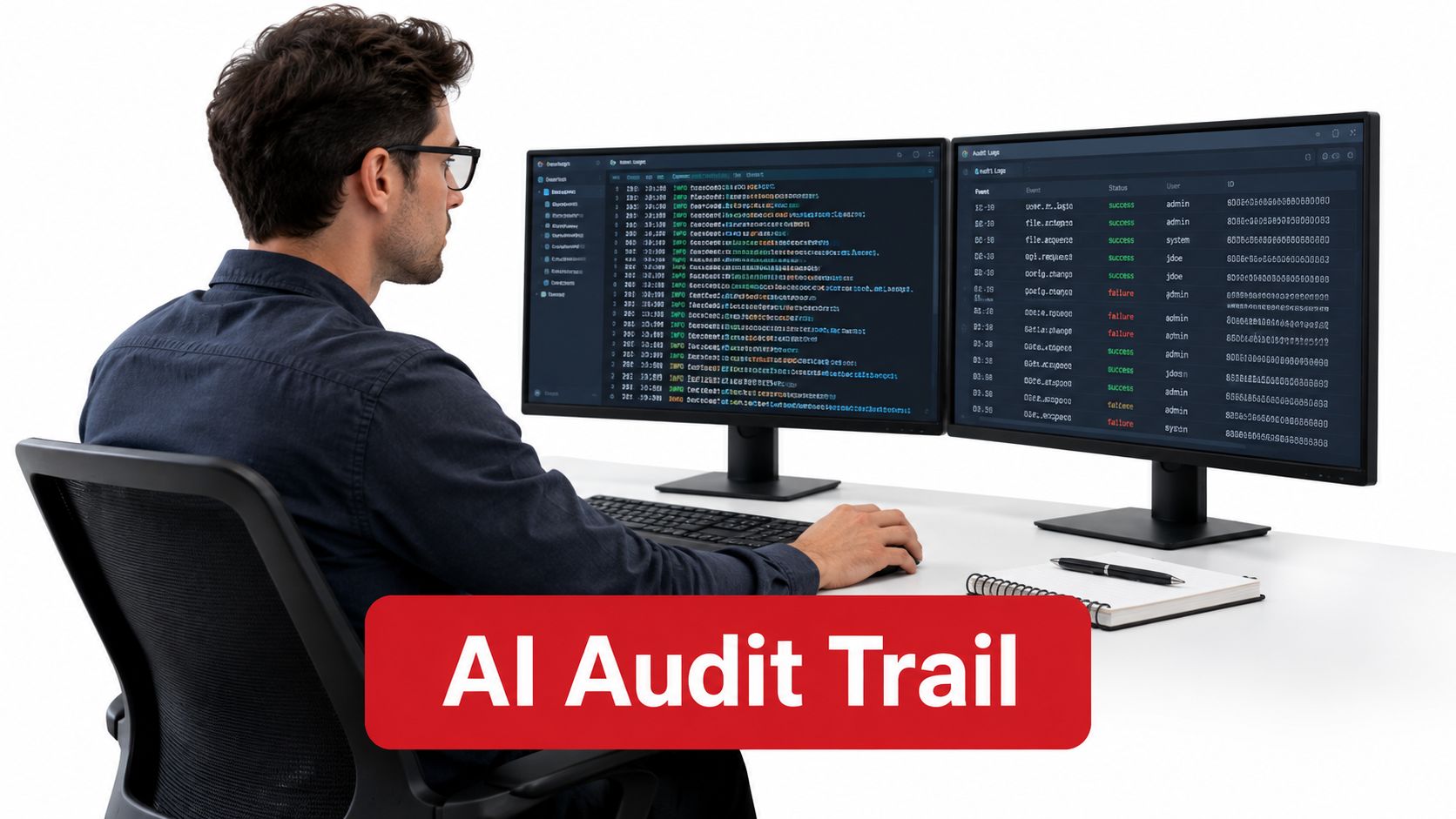
Most MSPs are already one client call away from an audit trail problem. An employee used a branded AI workspace, pasted sensitive customer material, and now the client wants to know who did it, what model handled it, what policy was active, and whether anyone approved the action. If the only record is a loose transcript, the MSP is guessing. That's not governance, and it's not defensible.

A real AI audit trail is an evidence layer, not a chat history. It has to support reconstruction, show human involvement, preserve the state of the system at the time of use, and survive long enough to matter in a dispute, review, or investigation. For MSPs serving SMB clients, that makes traceability a service deliverable, not a nice-to-have feature buried in a vendor demo.
Table of Contents
- The MSP Moment That Exposes a Missing AI Audit Trail
- The Regulatory Anchors That Shape an AI Audit Trail
- Minimum Events to Record for Client AI Workspaces
- Designing Retention Access and Evidence for SMB Clients
- Why Logging Prompts and Responses Is Not Enough
- Turning Trail Evidence Into MSP Reporting and Reviews
- Your MSP Buyer Checklist for AI Traceability
The MSP Moment That Exposes a Missing AI Audit Trail
The panic usually starts small. A client manager says an employee “just used the AI tool for a draft,” but the draft included customer details, internal pricing, or legal language that should never have left the client boundary. The MSP gets pulled in because the client wants names, timestamps, and proof, and nobody wants to admit they can't reconstruct the event.
What the client asks first
The first questions are always blunt. Who submitted the prompt, which workspace handled it, what model was active, what policy was in force, and did anyone review the output before it was reused? If the MSP can't answer those without digging through disconnected systems, the incident already became a governance problem.
That's why a minimum viable audit trail matters. The client doesn't need a folklore archive of every keystroke, and the MSP doesn't need a breach-sized blob of raw content. The client needs a clean chain of evidence that ties a material action to a person, a system state, and a result.
Practical rule: If the trail can't answer who, what, when, under which policy, and with what result, it isn't an audit trail. It's just logging noise.
For MSPs wrapping services around Prox.ia, the smarter posture is to define the evidence standard first and then verify which workspace controls, reporting views, and moderation outputs are available in the proposed deployment. Veevoo distributes the product, but the service design still belongs to the MSP.
The Regulatory Anchors That Shape an AI Audit Trail
The cleanest way to stop arguing about “enough logging” is to anchor the client policy in a framework. The EU AI Act, ISO/IEC 42001:2023, and NIST's AI Risk Management guidance all push MSPs toward traceable evidence, but they do it from different angles.
Start with the EU AI Act
For high-risk AI systems, Article 12 requires technical support for automatic recording of events throughout the system's lifetime, and Article 19 requires providers to retain automatically generated logs under their control for at least six months unless another law requires a different period. That means the trail has to support traceability of system use, human involvement, and operational events, not just basic application activity. The EU AI Act Article 19 text is the cleanest anchor for retention conversations with clients.
Add ISO 42001 and NIST for governance
ISO/IEC 42001 treats documented evidence as part of the AI management system itself. Internal audits, documented information, management reporting, and corrective action evidence all matter, which means the trail must support governance history, not only model output records. ISO 42001 audit guidance is useful when a client wants to know why “we can find the log later” isn't a governance answer.
NIST's AI RMF Playbook adds the operational lens. It recommends logging input data and relevant system configuration when an AI system is used outside its defined range of validity, and it calls for documented authorization protocols for access to sensitive training or production data. NIST's AI RMF Playbook gives MSPs a concrete way to talk about configuration context, sensitive data access, and traceable authorization.
Pick the framework that fits the client's risk profile, then let that framework drive the minimum evidence standard. Don't let a vendor's default report shape define your policy.
Minimum Events to Record for Client AI Workspaces
A usable trail starts with the event, not the transcript. A client workspace may generate prompts, outputs, tool calls, moderation outcomes, and human approvals, but the MSP only gets real reconstruction power when those events are linked together with consistent identifiers.
The fields that actually matter
For each material AI interaction, the trail should preserve a unique session or event ID, authenticated user or service identity, timestamp, model and configuration version, policy or guardrail version, input and output references, tool calls, errors, human interventions, and the final disposition. Those fields answer different questions, and each one closes a gap that raw chat text leaves open.
- Unique event ID: Connects every related action so the MSP can trace one incident end to end.
- Authenticated identity: Shows who initiated the action, whether that was a person or a service account.
- Timestamp: Proves when the event happened, which matters when policy versions, models, and approvals change over time.
- Model and configuration version: Tells the client which engine and settings produced the result.
- Policy or guardrail version: Shows which control logic was active when the action occurred.
- Tool calls and errors: Reveal whether the workspace pulled in external data, called another system, or failed mid-process.
- Human interventions: Capture review, override, or approval, which is where accountability usually lives.
- Disposition: Records whether the action was accepted, blocked, escalated, or corrected.
The key is linkage, not volume. A single event ID that ties together the prompt, retrieved content, moderation decision, and reviewer action is far more useful than a pile of separate exports.
Useful mindset: A transcript tells a story. An audit trail proves a control worked.
That's why MSPs should verify the workspace's current reporting behavior before promising anything to clients. If the deployment includes a multi-model AI workspace, this Prox.ia workspace overview is the kind of product page the MSP should review for confirmed behavior, not assumed behavior.
Designing Retention Access and Evidence for SMB Clients
Retention is where many MSPs get lazy. They either keep everything forever, which creates unnecessary exposure, or they keep too little, which kills their ability to answer a later question. The right answer is tiered, documented, and tied to the client's legal and operational reality.
Retention should follow risk, not convenience
The EU AI Act's six-month floor for certain high-risk logs is the baseline the client policy has to respect, but it's not a ceiling. If a client needs records for incident review, contractual evidence, or other legal obligations, the retention period can be longer. The point is simple, retention is a business and legal decision, not a storage default.
Access should follow roles. A client compliance officer may need full evidence packs, an MSP service lead may need service-review summaries, and a security engineer may need technical traces without unrestricted access to raw prompt content. Raw prompts can carry customer records, intellectual property, credentials, and regulated details, so the reader of the record should be narrower than the creator of the record wherever possible.
Protect the evidence like evidence
Logs need tamper-evident storage, access controls, integrity checks, and meta-logs for access to the logs themselves. If someone can edit the trail, the trail loses value the moment it matters. If someone can read the trail without a need to know, the MSP has just expanded the client's exposure surface.
A disciplined approach usually includes three questions:
- Who can read raw content? Keep that circle small and documented.
- Who can see decision metadata? Give service leaders enough context to troubleshoot and report.
- Who can export evidence? Restrict exports to named roles and log the export action.
The NIST AI RMF Playbook also recommends documenting authorization protocols for access to sensitive training or production data, which is a good standard to borrow for client policy work. MSPs should verify actual retention defaults and access controls with the deployed Prox.ia environment, not assume the workspace matches the policy on paper.
Why Logging Prompts and Responses Is Not Enough
A prompt-response transcript looks useful until the client asks the hard question: why did the system do that? The answer usually depends on version state, retrieved data, policy status, tool calls, and whether a human overrode the result. None of that is guaranteed to live in a simple chat export.
Transcript-only logging leaves gaps
A transcript may show that a user asked for a draft, but it won't necessarily show which model answered, what policy filtered the output, what retrieval source was used, or whether the reviewer edited the result before it left the workspace. Those missing pieces are exactly what auditors, clients, and incident responders need.
That's where a full event trail earns its keep. It gives the MSP a way to prove whether a block worked, whether a moderation action fired, whether a user's workflow was inside policy, and whether the output passed through human review before use. A transcript alone cannot do that reliably.
More logging can make things worse
Indiscriminate capture creates its own problem. It increases breach exposure, generates unusable volume, and buries decision evidence inside low-value telemetry. If the client can't search or interpret the record, the MSP still can't reconstruct the incident, even if every keystroke was saved.
The practical answer is to capture decision metadata, not private reasoning spillover. Record tool actions, policy outcomes, reviewer rationale, and state changes. Skip the temptation to store internal reasoning as if volume itself were proof.
For client-facing prompt controls and moderation workflows, MSPs should also verify what the workspace reports before promising coverage. The Prox.ia prompt moderation page is the kind of product-specific reference that belongs in a diligence pass, not a sales pitch.
Turning Trail Evidence Into MSP Reporting and Reviews
Audit evidence has to show up where the client already looks, or it becomes shelfware. MSPs already run monthly reviews, incident writeups, and QBRs. The AI trail should sit in that same rhythm, not off to the side as a separate security project.
Make the trail part of the service cadence
A practical monthly workflow looks like this. Sample a few material AI interactions, try to reconstruct them from the record, and note where the chain breaks. Pull policy exceptions into the service review. Attach trail evidence to incident postmortems when something was blocked, edited, or escalated. Then roll those findings into a QBR summary that shows model changes, policy outcomes, and human review activity.
That's the reporting model clients understand. It's the same logic MSPs already use for patch status, license reconciliation, and open security items, just applied to AI evidence instead of endpoints or software counts.
The trail is most valuable when it changes the meeting, not when it sits in storage.
This is also where an MSP can decide whether a governed AI offer belongs in a broader service package. Veevoo, Inc. distributes Prox.ia for MSPs that want to wrap workspace access, onboarding, policy guidance, moderation reporting, and recurring support around client AI use, but the actual reporting promises still need to be verified against the deployment.
CISA's 2025 asset inventory guidance treats logging information as a high-priority field, which is a useful reminder that how records are collected matters as much as what's collected. CISA's inventory guidance backs the idea that logging is part of detection and investigation, not an administrative afterthought.
Your MSP Buyer Checklist for AI Traceability
This is the conversation to have with any AI workspace vendor, including Prox.ia, before a client signs. The point isn't to demand magic. The point is to confirm whether the platform can support the evidence standard the client needs.
| Evidence category | Question to ask the vendor | Why it matters for the client |
|---|---|---|
| Activity recorded | What exact events are captured for prompts, outputs, tool use, moderation, human review, and overrides? | The client needs decision-grade evidence, not a partial transcript. |
| Retention | How long are logs retained, and can the MSP document or adjust the retention decision? | Retention has to match risk, contract terms, and legal obligations. |
| Access | Which roles can view raw content, decision metadata, and exported evidence? | Access has to be narrow enough to protect client data. |
| Integrity | How are records protected against silent edits or unauthorized deletion? | The trail has to hold up under dispute or review. |
| Reporting | What evidence can be surfaced in recurring service reviews or client reports? | The trail has to become a deliverable the client can use. |
| Reconstruction | Can the workspace support a sample reconstruction test from a real incident or simulated case? | If the trail can't rebuild an event, it isn't useful in practice. |
A vendor that answers those questions clearly is useful. A vendor that waves at “visibility” and “AI governance” without concrete record behavior isn't ready for client-facing auditability. MSPs should verify deployment specifics on the product page and in the contract, then build the service around those confirmed behaviors.
For MSPs that want to package governed AI services with a reseller motion, the Prox.ia MSP reseller page is a reasonable next stop for scoping the offer before any client commitment.
Veevoo, Inc. helps MSPs build practical client offers around governed AI workspaces and the operational reporting that goes with them. If this audit-trail checklist is the kind of service design your team needs, visit Veevoo, Inc. and scope the next step with a restrained conversation about fit, deployment, and client policy.