

A 12-person services firm usually doesn't call for an AI strategy deck. It calls because employees are already pasting client text into free tools, the owner is uneasy about where that data goes, and no one can answer the simplest question: which task should AI touch first?
That's the true entry point for ai for small business. Not a model comparison. Not a shiny chatbot demo. The first job is to find one recurring workflow that is worth changing, low risk to test, and easy to review by a human.
Table of Contents
- The Small Business That Knows It Should Use AI but Does Not Know Where to Start
- Why Small Business AI Adoption Looks Different from Enterprise Coverage
- A Relevance Test That Beats a Use-Case List
- What Governed AI Looks Like for a Small Business Client
- Cloud, Private, and On-Premises Deployment Choices
- The Reseller Service Stack You Actually Deliver
- Designing Low-Risk Pilot Workflows with Human Review
- From Tool Access to a Recurring AI Service
The Small Business That Knows It Should Use AI but Does Not Know Where to Start
A small business owner can see the pressure building before any formal project starts. Someone in sales is using a public AI tool to draft follow-up emails. Someone in operations is asking it to summarize long PDFs. Nobody has written down what is allowed, what is off limits, or who checks the output before it leaves the building.
That's why MSPs keep running into the same problem. The client does not need a lecture on artificial intelligence, it needs a guided decision about relevance, risk, and workflow fit. If the first conversation starts with tool selection, the rollout usually drifts.
Start with the work, not the model
The useful question is blunt, which recurring task is painful enough, frequent enough, and reviewable enough to justify AI support? For a small firm, that might be proposal drafting, customer response prep, document summarization, or internal knowledge lookup. If the work is rare, highly regulated, or hard to verify, it is usually a bad first pilot.
Practical rule: if the owner cannot explain the task in one sentence, the pilot is probably too vague.
An MSP adds value by running the discovery, defining the guardrails, and deciding whether the task belongs in a low-risk pilot or should be left alone. That is a service motion, not a software resale motion. The client gets a process, not just access.
Why Small Business AI Adoption Looks Different from Enterprise Coverage
The broader market is moving, but the smallest firms are not moving at the same pace as larger businesses. OECD data covering businesses with at least 10 employees show that the share using AI rose from 5.6% in 2020 to 14% in 2024, a 2.5-fold increase over four years, and the 2024 figures show a clear size gradient, 11.9% of firms with 10–49 employees used AI, compared with 20.4% of firms with 50–249 employees and 40% of firms with at least 250 employees (OECD report on SME AI adoption).
That gap matters more than the headline growth. It means many small clients are arriving late, with thinner internal process discipline and less room for trial and error. They do not need a grand transformation program. They need someone to make the first rollout manageable.
Momentum does not mean uniform readiness
The same pattern shows up in OECD survey work on SME digitalisation. 39% of surveyed SMEs reported using at least one AI application in core business activities or products, up from 26% in 2024, while generative AI was the most widely used category at 26% (OECD SME digitalisation survey). The adoption rate looks stronger when businesses already have stronger digital habits, which is exactly why structured onboarding matters.
The market is not asking whether AI exists. It is asking whether a small business can operationalize it without making a mess.
The case for a governed service is straightforward. Small firms need help with onboarding, user guidance, policies, review cadence, and change management. Access alone is not enough, because adoption without structure often becomes shadow use.
A Relevance Test That Beats a Use-Case List
Most AI advice starts with a list of use cases. That's the wrong move. A 2025 U.S. Small Business Administration analysis found that nearly 82% of firms with fewer than five employees that did not plan to use AI cited lack of relevance as the reason, compared with 6.7% who cited insufficient AI knowledge and 6.3% who cited privacy concerns (SBA analysis).
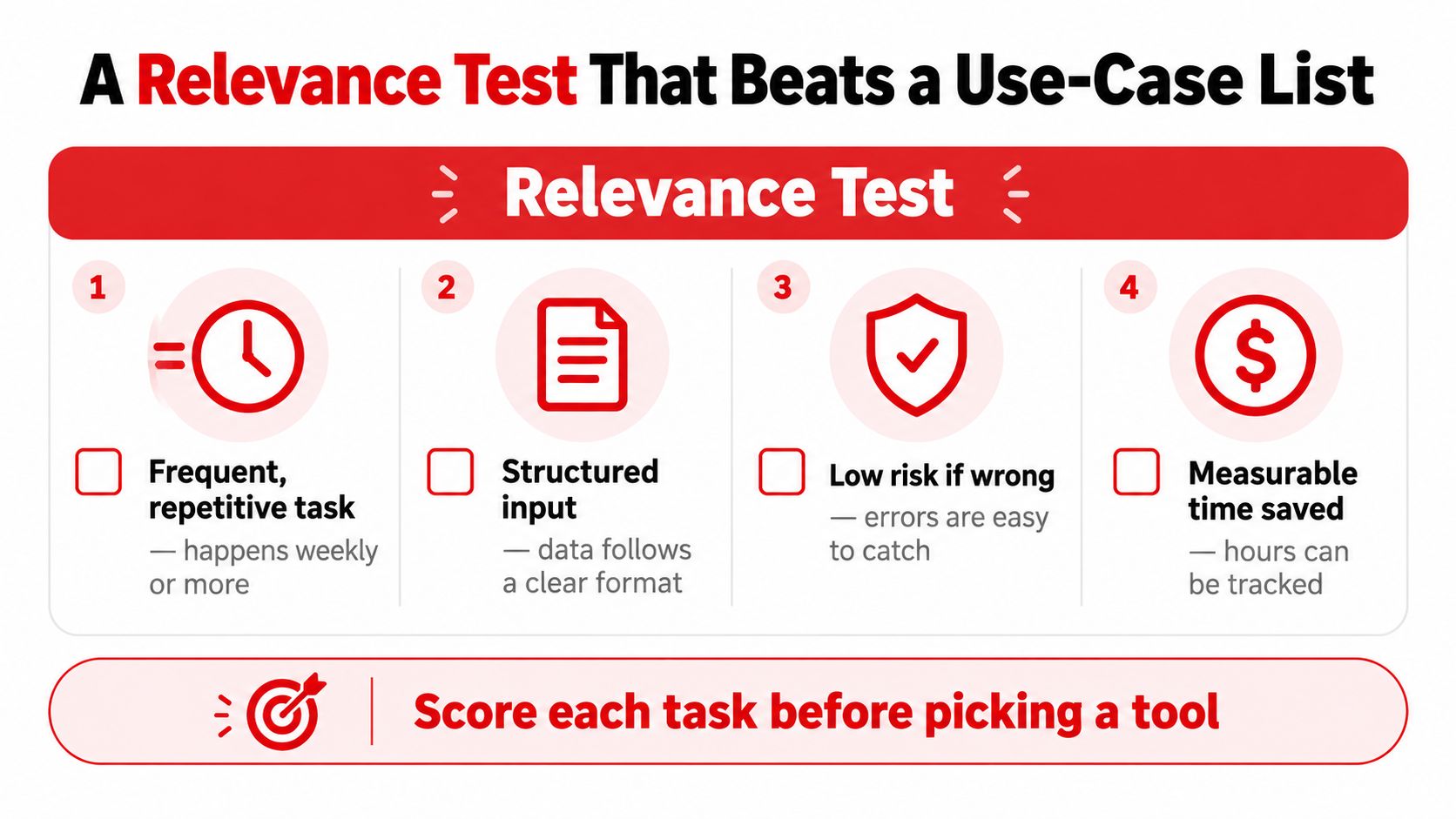
That is the clearest sign that problem selection beats enthusiasm. If the owner does not see a concrete business problem, more tool options will not help. MSPs should stop pitching “AI adoption” and start asking whether a specific task is frequent, structured, reviewable, and expensive enough to matter.
Run a short workflow audit
The audit can be simple. First, list the recurring tasks that consume staff time. Then sort them by how often they happen, how much text or structure they involve, and whether a human can spot mistakes quickly.
Good early candidates usually include drafting, summarization, document transformation, support-response preparation, and internal knowledge retrieval. Poor candidates are the ones with high compliance weight, unclear inputs, or outcomes that depend on human judgment more than language processing.
If a task does not save visible time or reduce visible rework, it should stay off the pilot list.
That discipline also helps stop bad pilots before they spread. If the expected gain is too small, the work should be left alone. Relevance is not a one-time checkbox, it's a recurring filter the MSP should keep applying as the client's processes change.
What Governed AI Looks Like for a Small Business Client
Governance gets vague fast unless it is tied to actual service actions. NIST's Generative AI Profile, published as NIST AI 600-1 in July 2024, identifies 12 risk categories unique to or amplified by generative AI and connects them to the AI Risk Management Framework's Govern, Map, Measure and Manage functions (NIST AI 600-1). That framework is useful because it gives the MSP a delivery model, not just policy language.
Governance becomes named administrators, documented acceptable-use rules, and clear ownership of data inputs. Mapping becomes a per-client review of which workflows can touch AI and which should stay out. Measuring becomes recurring consumption tracking and moderation reporting. Managing becomes incident handling and policy refresh.
Turn the framework into operations
A small business does not need a giant governance binder. It needs a repeatable operating model that answers a few questions every month.
- Who can submit what: define acceptable and prohibited inputs before rollout.
- Who reviews outputs: assign human review for sensitive or customer-facing work.
- What gets measured: track usage patterns, moderation signals, and exceptions.
- What happens when something breaks: document escalation and follow-up.
A restraint matters here. Moderation can reduce some risks, but it cannot detect every sensitive item or guarantee compliance. That means an MSP should present governance as an implemented practice, not as a certification badge.
The internal workflow guidance at Prox.ia prompt moderation belongs in the same category. It's a service control, not proof that every risky input will be caught.
Cloud, Private, and On-Premises Deployment Choices
Deployment is where small-business AI projects get real. The choice is less about branding and more about where data sits, who manages infrastructure, what task types are supported, and how much operational burden the client is willing to carry. Those trade-offs should be confirmed against the proposed setup, not assumed.
A cloud workspace is usually the cleanest starting point for general productivity. Private or on-premises deployment only makes sense when the client's sensitivity level, workflow design, or operational constraints justify the added overhead. The point is not to chase the most locked-down option by default.
The Prox.ia multi-model AI workspace should be checked against the actual client use case before anyone promises fit. Supported models, branding, infrastructure responsibilities, and deployment behavior all need verification, because feature parity is not something to assume.
Deployment Starting Points by Client Profile
| Client profile | Suggested starting deployment | What to verify with the vendor |
|---|---|---|
| Professional services firm with standard drafting and internal knowledge work | Cloud workspace | Data handling, supported models, admin controls, and branding options |
| Client with sensitive document workflows | Private deployment | Infrastructure ownership, data residency, and task support |
| Client with strict internal hosting preferences | On-premises deployment | Hardware burden, model support, and management requirements |
The decision is rarely permanent. A client may begin with a cloud setup for low-risk work and later add a more controlled deployment for a narrower workflow. That is a normal progression, not a failure of the first choice.
The Reseller Service Stack You Actually Deliver
The service the client pays for is not “AI access.” It's the wrapper around that access. That includes workspace onboarding, administrator guidance, prompt workshops based on the client's real work, usage budgets, moderation reporting, and recurring review conversations. Prox.ia belongs in that service motion as the workspace layer an MSP can resell, but every capability should be verified against the product page and the actual deployment being proposed.
The MSP AI reseller page is the right place to confirm what is documented for the offer. Veevoo, Inc. is the distributor and partner, not the software vendor, so the distinction matters when the client asks who supports what.
What the client should expect
A governed rollout should feel more like onboarding a managed service than buying a box of features. The MSP should set the cadence, define the limits, and keep the client's named admin in the loop.
Working rule: if the client cannot describe who owns prompt policy, review cadence, and exception handling, the rollout is too loose.
The recurring service model also keeps the conversation honest. Moderation reporting supports review, but it does not eliminate the need for judgment. Budgets help control consumption, but they are not a substitute for governance. Prompt workshops improve adoption, but they do not replace policies.
Designing Low-Risk Pilot Workflows with Human Review
The best first pilots are narrow, visible, and easy to verify. OECD survey data show that 31% of SMEs reported using generative AI, and 65.1% of those users said it improved employee performance, with separate estimates finding average time savings of 2.8% of working hours among users in AI-exposed occupations in Denmark and 5.4% in a U.S. survey (OECD generative AI and SME workforce report). Those numbers support augmentation, not blind automation.
That's why the first pilots should keep humans in the loop. A sales workflow can draft proposal sections and follow-up emails from approved inputs. A support workflow can prepare first-draft replies for technician review. An operations workflow can summarize long documents into structured notes.
Keep the pilot small enough to measure
The first deployment should establish a baseline before anything goes live. Track how long the work takes now, how often revisions happen, and where escalations occur. Then compare the pilot against that baseline after rollout.
The image of a “fully automated” small-business workflow is usually misleading. The win is task compression, where AI handles the first pass and people keep responsibility for verification and judgment. That structure is safer and easier to explain to clients.
When Prox.ia is being evaluated, supported integrations should be checked against the documented offer rather than assumed from the category label. The pilot should prove that the workflow fits the client, not that AI is magical.
From Tool Access to a Recurring AI Service
Small-business governance concerns are not abstract. An October 2025 small-business technology survey found 44% of respondents identified data privacy as a concern, 43% worried about output accuracy, 31% cited employee training, and 27% reported lacking in-house expertise (small-business technology survey). Those are service tickets waiting to happen unless the MSP builds a repeatable operating model.
The fix is not another vendor badge. It is a lightweight service routine: classify acceptable and prohibited inputs, assign approval thresholds, train users with realistic prompts, monitor consumption and moderation signals, and document exceptions. That is what makes AI observable and revisable in a small firm.
Treat governance as an ongoing review cycle
The owner does not need a grand policy package. The owner needs evidence that the client's team is using AI inside clear boundaries, with real review points and a named owner.
That is where the MSP earns its fee. The service is the process around AI, not just the tool itself. If that process is in place, the client can grow the use case safely. If it is missing, even a simple pilot can turn into shadow AI with no accountability.
Veevoo, Inc. helps MSPs package governed AI as a service instead of a loose collection of user logins. For teams ready to scope a client rollout, review the Prox.ia product details and visit Veevoo, Inc. to contact the team about fit, workflow design, and next steps.