

The invoice batch is ready, but the service delivery manager spots a problem: the client's managed endpoint quantity doesn't agree with the RMM inventory. A separate license review shows subscriptions assigned to disabled users. Finance needs an answer before invoicing, and the technician who handled the latest onboarding has supporting details in a service ticket rather than the billing record.
A defensible billing reconciliation process resolves those differences before they become client disputes or unsupported charges. For an MSP, that means comparing contracted services, deployed assets, license records, and PSA billing lines, then documenting the decisions behind every material discrepancy.
Table of Contents
- Why MSPs Need a Billing Reconciliation Process
- Preparing Your Data Sources
- Mapping Billing to Inventory and Licenses
- Building Automated Match Rules
- Handling Exceptions with a Documented Review
- Audit Trails and Monthly Report Generation
- Roles, Responsibilities, and a Sustainable Cadence
Why MSPs Need a Billing Reconciliation Process
Illustrative scenario: An SMB client's endpoint inventory exceeds the quantity on its recurring managed-services agreement. Some devices might be newly deployed and billable. Others might be retired records, replacements, or assets excluded from the agreement. Meanwhile, licenses assigned to disabled users might represent unnecessary spending, retained access for an approved purpose, or subscriptions subject to a continuing commitment.
None of those findings justifies changing an invoice without investigation. The operational record establishes what appears to exist; the contract establishes what the MSP may charge. A difference is an exception to review, not an automatic billing instruction.
Reconciliation Is a Control, Not a Count Comparison
Financial reconciliation brings together records, standardizes them, matches corresponding transactions, investigates exceptions, and preserves evidence. A payment-reconciliation survey summarized by Kani found that 47% of respondents identified fragmented data as their leading barrier to accurate reporting. That finding concerns payment reconciliation broadly, not MSP billing specifically, but the underlying control problem is relevant: disconnected records make reliable comparisons difficult.
For an MSP, a useful reconciliation must answer several distinct questions:
- Contract coverage: Does the agreement authorize the service, quantity basis, and applicable rate?
- Delivery evidence: Was the asset, user, or subscription in scope during the billed service period?
- Billing completeness: Does the PSA include the charge that the agreement supports?
- Client protection: Does the invoice exclude unsupported charges and include approved credits?
Revenue leakage deserves attention, but so does overbilling. A process designed only to find additional charges isn't a balanced control.
Make Ownership Explicit
The service delivery manager should define who owns each source, which rules establish a match, where exceptions wait for review, and who signs off before invoice release. Without those decisions, staff can agree on a total while disagreeing about what belongs in it.
Practical rule: Equal totals don't prove accurate billing. An omitted asset and an incorrectly included asset can cancel each other out.
Spreadsheets can support a controlled starting point, provided the MSP preserves source extracts and review history. A shared workbook that staff repeatedly overwrite is different: it may show the current answer without showing how anyone reached it. The test is whether another reviewer can reproduce the conclusion from retained evidence.
Preparing Your Data Sources
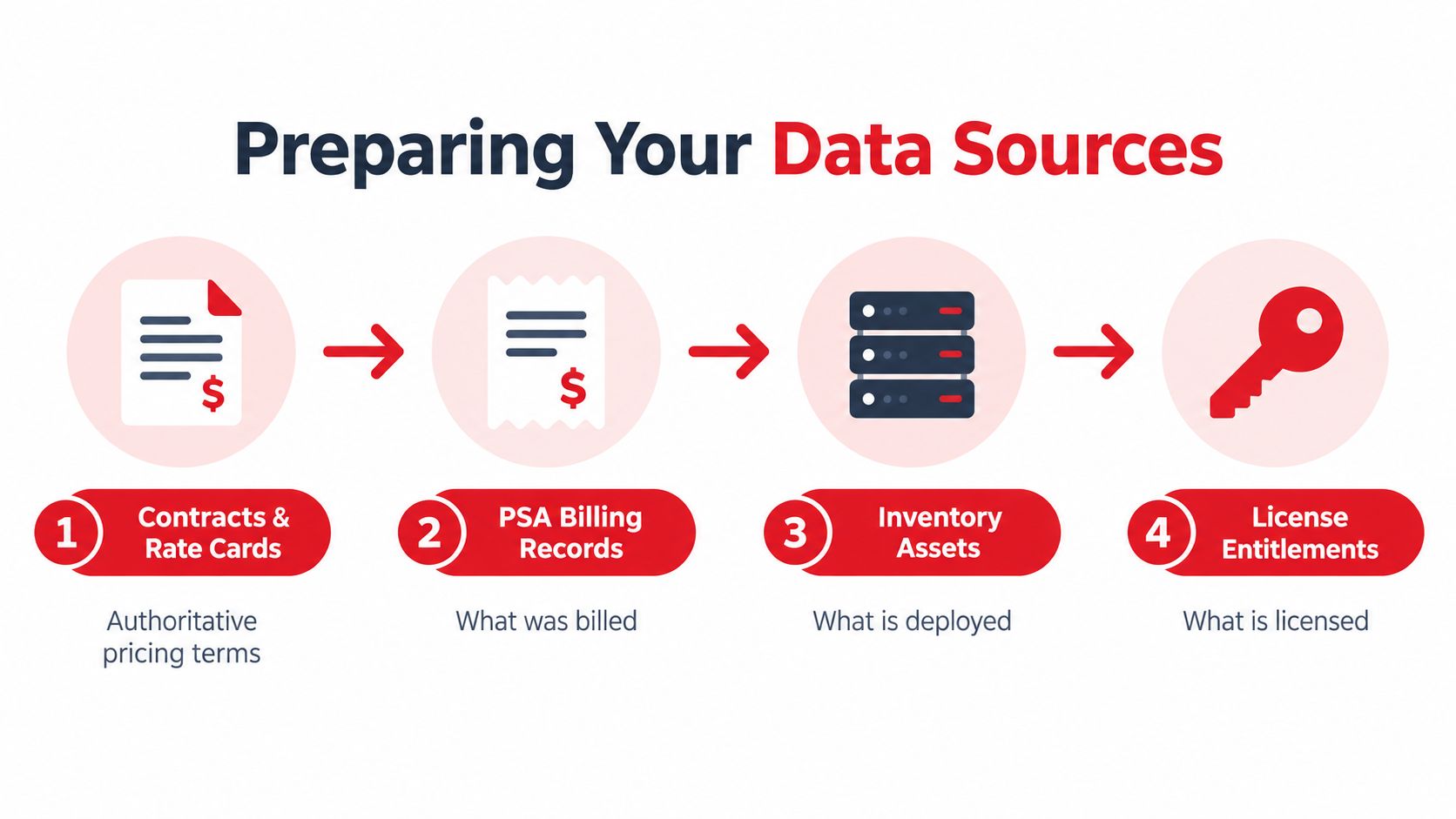
Start with a controlled billing register, not a collection of unrelated exports. Each record should identify the customer, agreement, service, billing period, supporting operational record, and draft billing line. Preserve the original extracts separately so normalization doesn't erase the underlying evidence.
Assign Authority by Data Type
No system should be treated as authoritative for every question. The PSA may hold recurring charges, but those charges aren't proof that the contract remains current. An RMM export may show an installed agent, but that alone doesn't establish billable status.
| Record set | Authority it should provide | Preparation check |
|---|---|---|
| Contracts and rate cards | Approved scope, pricing, exclusions, and effective dates | Include amendments and termination terms |
| PSA billing records | Draft recurring and usage-based charges | Separate credits, adjustments, and pending changes |
| Asset inventory | Identified devices and operational status | Retain customer ownership and observation dates |
| License and entitlement records | Purchased rights, assignments, and subscription terms | Distinguish assigned, available, and committed quantities |
| Payment and accounting records | Settlement and posting evidence | Keep payment status separate from service eligibility |
The account owner should validate commercial terms. Technical leads should validate asset status. The license administrator should explain entitlement records, while finance owns invoice, tax, currency, and payment fields.
Normalize Without Losing Meaning
Create a customer crosswalk when names differ between systems. Preserve original identifiers alongside normalized values, and document how aliases map to the same customer or service. Standardize currencies and date formats before comparing amounts or service periods.
Useful preparation checks include:
- Extract timing: Record when each file was produced and which service period it represents.
- Identifier quality: Flag blank serial numbers, ambiguous usernames, and missing agreement references.
- Status definitions: Explain whether inactive, retired, disabled, and disconnected have different operational meanings.
- Financial completeness: Include applicable taxes, credits, reversals, and partial payments rather than comparing invoice totals alone.
Keep lifecycle context available during preparation. A device marked for retirement may still appear in operational tools while its replacement is being deployed. Hardware, warranty, and OS lifecycle planning provides relevant context for that review, but a lifecycle label shouldn't determine the billing outcome by itself.
The preparation owner should publish a completeness check with each register. Missing exports, stale records, and unresolved customer mappings belong on that check. An incomplete input set should remain visible rather than slipping into a seemingly clean reconciliation.
Mapping Billing to Inventory and Licenses
Map individual supporting records to the appropriate billing service, even when the PSA presents an aggregated quantity. A recurring endpoint line needs a supporting population of eligible devices. A user-based service needs an eligible user population, which may differ from the device population.

Build Relationships Around Stable Identifiers
Use the customer and agreement as the boundary for every comparison. Within that boundary, map assets using stable identifiers such as serial numbers or persistent device IDs. Hostnames can help investigation, but a renamed device shouldn't become an additional billable endpoint merely because its display name changed.
For licenses, connect the subscription or SKU to its entitlement record, user assignment, and applicable billing service. Preserve the account identifier as well as the display name. Where the contract bills purchased commitments rather than active assignments, the commitment record must remain part of the comparison.
The mapping should distinguish:
- Contracted and deployed: Confirm that the service period and billing basis agree.
- Deployed but not contracted: Investigate onboarding authorization, scope, or an incomplete agreement change.
- Contracted but not deployed: Check whether the agreement bills reserved capacity, a minimum commitment, or an undelivered service.
- Billed without supporting records: Require evidence before accepting the charge.
Interpret Mismatches Before Calculating Adjustments
Illustrative example: An RMM inventory contains more endpoint records than the PSA's recurring quantity. The reviewer identifies replacement devices that overlap with outgoing hardware and newly onboarded devices awaiting commercial confirmation. Only the records supported by the agreement and relevant dates should affect billing.
Another illustrative review finds a license assigned to a disabled account. That finding warrants investigation, but it doesn't prove that the client is owed an immediate credit. The reviewer should check subscription commitments, approved retention needs, and whether the service is billed by purchased entitlement or active assignment.
A disabled account, an unused license, and an invalid invoice charge are different findings. The reviewer must establish which finding the evidence supports.
Microsoft 365 license management is a relevant area for this comparison, particularly when account status and license assignment need to be reviewed together. Specific subscription handling and supported connectors should be confirmed against the proposed environment.
Keep the mapping output separate from the adjustment decision. It should identify matched records and explain missing or conflicting relationships. Commercial approval belongs in the exception workflow, not inside a technical inventory cleanup.
Building Automated Match Rules
Automate comparisons only after the MSP can explain them in plain language. A rule that nobody can describe is difficult to test, defend, or correct when a client challenges the result.
The strongest starting point is rule-first matching. Ramp's invoice-reconciliation guidance supports normalizing records, applying defined comparisons and tolerances, and classifying exceptions. It also recommends quarterly threshold reviews and investigating categories responsible for more than approximately 15% of exceptions, a practitioner benchmark rather than a universal requirement.
Separate Evidence From Similarity
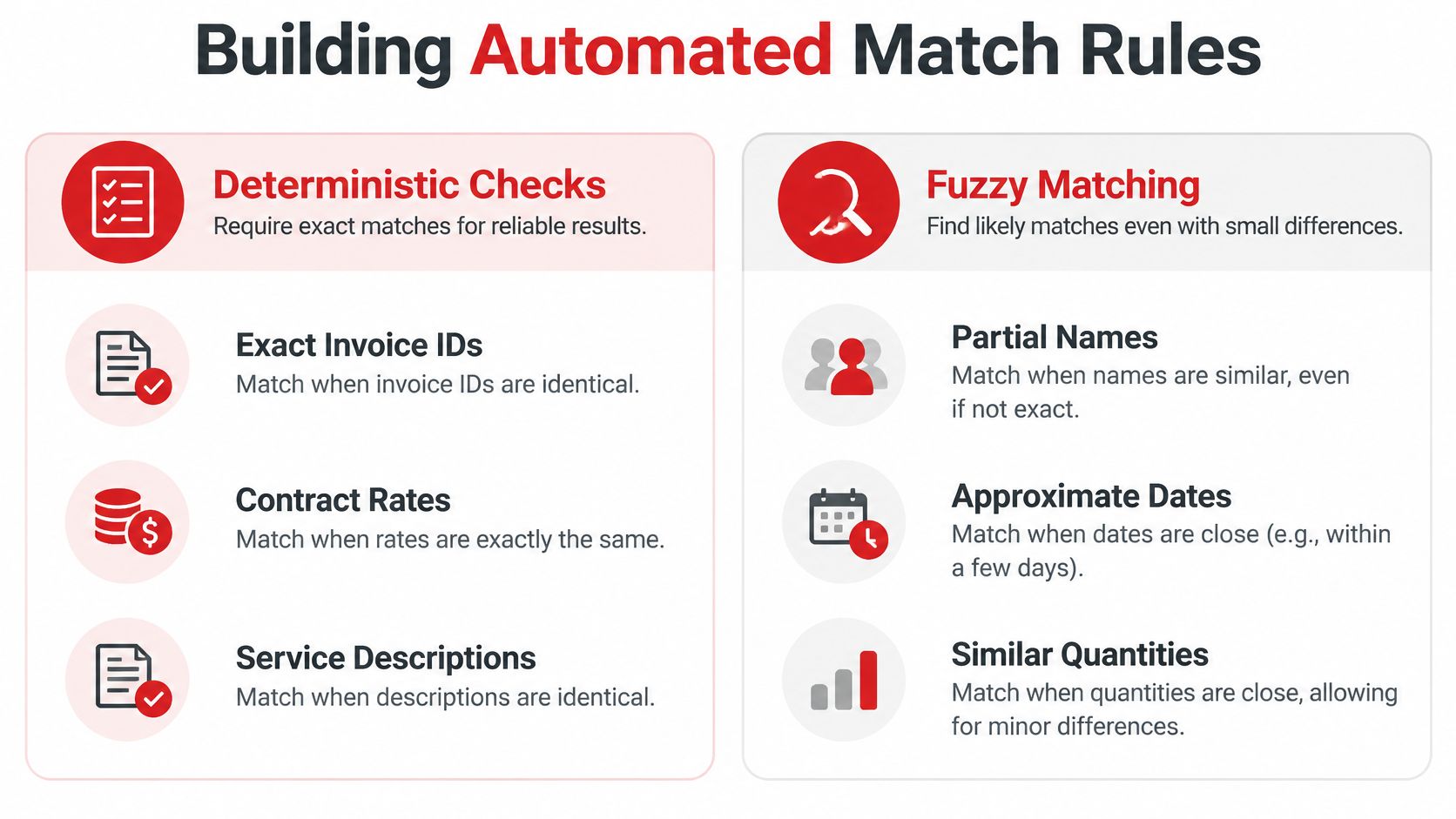
Deterministic checks compare explicit relationships: customer IDs, agreement references, device IDs, contracted rates, service dates, invoice references, and payment references. These checks should establish the strongest matches before the workflow considers less certain candidates.
Fuzzy matching can help find records with spelling differences, inconsistent descriptions, or incomplete references. It should propose a relationship for review, not decide that similar names represent the same customer or service. Approximate quantities are particularly weak evidence when the quantity itself determines the charge.
A practical rule specification should contain:
- Required evidence: Fields that must exist before the record can qualify.
- Comparison logic: The exact fields and relationships being tested.
- Tolerance rationale: Why a permitted difference is commercially and operationally acceptable.
- Failure route: The exception category and responsible reviewer.
- Rule version: The effective date and approval history for the logic.
Classify Results Without Hiding Uncertainty
Use statuses such as matched, partially matched, duplicate, missing, overbilled, underbilled, and unresolved. Define each status so technicians and finance staff interpret it consistently. A partial match should identify what agrees and what remains unsupported.
Tolerances should follow the agreement and accounting policy. A permitted rounding difference shouldn't become a general allowance for quantity discrepancies. Likewise, an agreed service-date adjustment shouldn't excuse a charge outside the contract term.
Test proposed rules against known exceptions before allowing them to clear records. Include duplicate device records, replacement overlaps, missing amendments, stale rates, and service cancellations. The test should examine false matches as well as records that failed to match.
Before implementation, baseline transaction volume, cycle time, manual touches, exception count, and exception value. After implementation, compare match rate and resolution time against that baseline. Those measurements help the MSP distinguish useful automation from a rule change that merely suppresses inconvenient exceptions.
Handling Exceptions with a Documented Review
An exception queue should produce decisions, not just collect discrepancies. Each item needs enough context for an assigned reviewer to establish what happened, determine the financial effect, and obtain the necessary approval.
Illustrative case: A recurring charge remains after a service disconnection. The reviewer checks the cancellation request, effective date, contractual notice period, operational removal evidence, and draft invoice. The charge may be wrong, or it may cover a valid notice period. The service's current status alone doesn't settle the question.
Preserve the Investigation Record
The exception record should retain the evidence needed to reconstruct the decision:
| Evidence field | What the reviewer records |
|---|---|
| Source documents | Relevant agreement, extract, ticket, invoice, or credit |
| Variance | Affected quantity and monetary exposure |
| Triggered rule | The comparison that failed |
| Ownership | Investigator and escalation contact |
| Decision | Accepted, corrected, deferred, or rejected, with rationale |
| Authorization | Approver and timestamp |
| Corrective action | Billing change, credit request, source repair, or follow-up |
Accepting a discrepancy requires a documented reason. If a minimum commitment explains a difference between deployed quantity and billed quantity, the reviewer should reference the applicable term. A note saying “looks correct” doesn't establish that connection.
Correcting a discrepancy requires evidence that the correction reached the right destination. Updating an asset record doesn't prove that finance adjusted the invoice. The investigator should retain the resulting billing record or approved credit reference before closing the item.
Resolve the Cause, Not Just the Current Invoice
Illustrative case: Similar invoice lines appear to be duplicates. Finance checks the customer, service period, agreement reference, and underlying service. The lines may cover separate obligations, or the PSA may contain a duplicated recurring charge. If the charge is duplicated, the reviewer should correct the current invoice and investigate the recurring setup.
Review standard: An exception is complete when the decision is authorized, the action is evidenced, and any remaining follow-up has an owner.
Prioritize exceptions using monetary exposure, age, client impact, and invoice-release deadlines. A low-value formatting problem shouldn't displace an unsupported material charge merely because it appeared earlier in the queue.
Keep unresolved issues explicit at close. The approver should decide whether an affected line must be held, whether an agreed treatment permits release, or whether further client communication is required. Staff shouldn't erase uncertainty by relabeling an unresolved item as matched.
Audit Trails and Monthly Report Generation
A monthly report should summarize a reproducible control, not replace the underlying evidence. The audit trail should show what was compared, when the review occurred, which discrepancies were accepted or corrected, and who authorized the outcome.
Preserve the source snapshot references, applicable rule version, investigation history, and resulting billing action together. A reviewer should be able to move from a reported adjustment back to its supporting records without reconstructing an email conversation.
Report Financial Exposure Alongside Activity
Reconciliation dashboard guidance from DOKKA's DOST publication recommends tracking matched value, unresolved value, duplicate value, exception age, recurring causes, and recovery or credit outcomes. Those measures help prevent a strong match percentage from concealing a small group of financially significant errors.
A useful monthly summary separates:
- Coverage: Records and value reviewed, plus any sources excluded from the run.
- Open exposure: Unresolved amounts, aging, owners, and next actions.
- Completed outcomes: Approved corrections, confirmed credits, and recoveries.
- Recurring causes: Repeated source-data defects or rule problems requiring management attention.
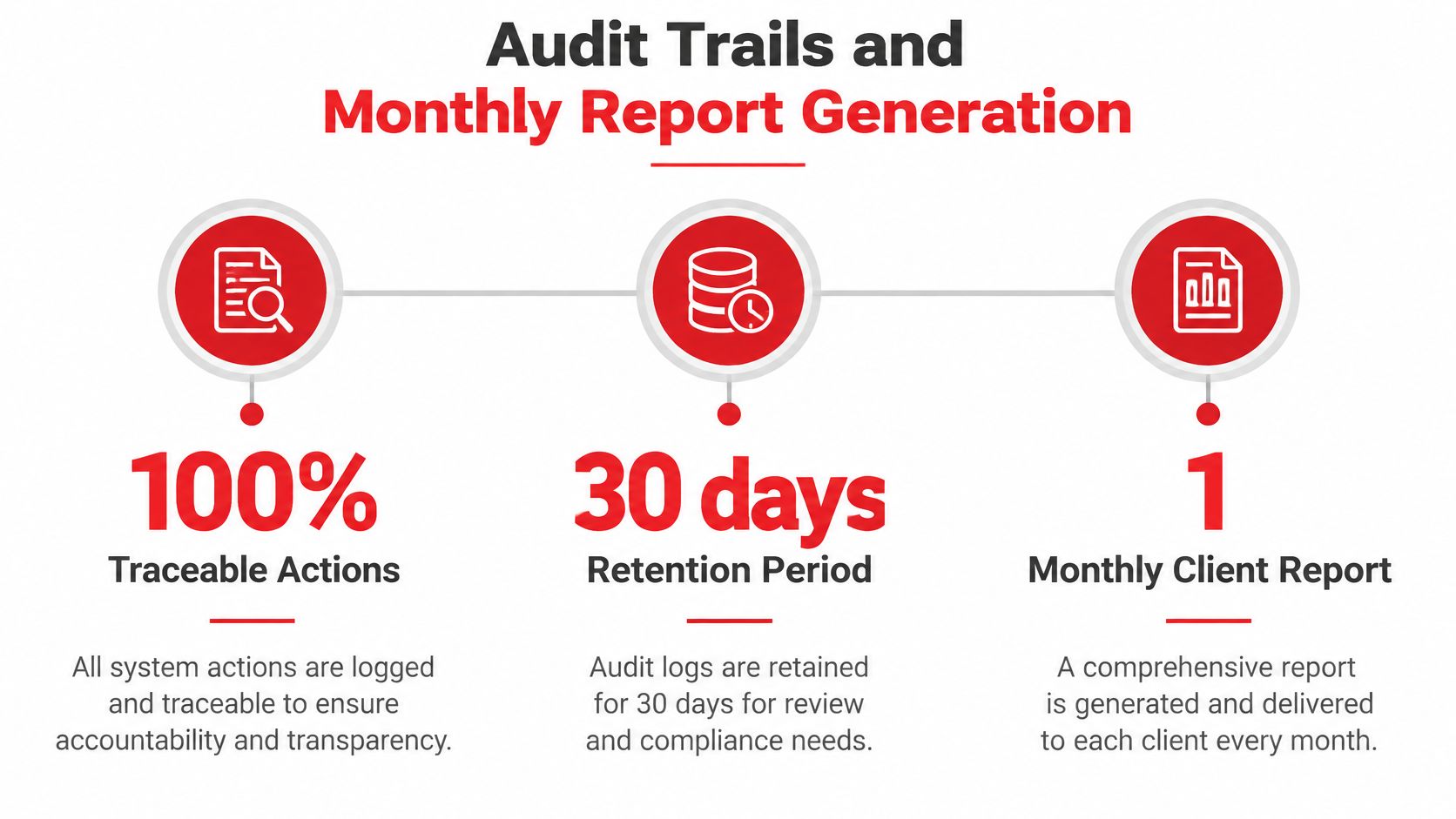
The following visual illustrates the reporting concept. Its displayed figures aren't prescribed control targets or a records-retention policy; retention should follow the MSP's applicable contractual, legal, and accounting requirements.
Turn Reconciliation Evidence Into Client Decisions
Client reporting should explain the service and billing implications without exposing unnecessary operational detail. A QBR might address unresolved agreement changes, license commitments awaiting renewal decisions, or a recurring onboarding handoff problem. It shouldn't present every technical exception as a client billing error.
Automated monthly reporting is relevant to packaging operational findings for recurring client reviews. Report templates, available data, and supported workflows should be confirmed for the intended deployment.
Keep internal investigative notes separate from the client-facing summary. Finance and service delivery still need the detailed evidence, while the SMB client needs a clear account of decisions, outstanding actions, and any effect on charges. That separation makes the report useful without sacrificing accountability.
Roles, Responsibilities, and a Sustainable Cadence
Separate data preparation, matching, investigation, approval, and final posting wherever staffing permits. The Fiserv/BAI report on automated reconciliation and internal controls states that lack of internal controls enabled fraud in 30% of examined cases, while perpetrators overrode existing controls in 19%. These aren't MSP-specific figures, but they reinforce why unchecked adjustment authority deserves attention.
Give Each Handoff an Owner
Technicians should maintain asset evidence. License administrators should validate assignments and commitments. Account owners should confirm commercial scope, service delivery managers should approve operational conclusions, and finance should control invoice posting. Smaller teams can use an independent owner review where full separation isn't practical.
Reconcile throughout the month, then perform a close review of unmatched items and financial totals. A sustainable starting checklist is:
- Assign sources: Name the owner of each required extract.
- Document rules: Approve billing eligibility and tolerance definitions.
- Control exceptions: Require evidence, ownership, and authorization.
- Confirm closure: Check that approved actions reached billing.
- Review causes: Correct repeated handoff and data-quality problems.
Volgap is an operational visibility option for connecting management, identity, security, license, and billing data across client environments. Its role can include supporting endpoint-to-PSA comparisons and license reviews alongside existing RMM, PSA, and security tools. Supported connectors and deployment fit require confirmation; the documented review remains the MSP's responsibility.
As a software distribution and enablement partner, Veevoo, Inc. offers Volgap to MSPs evaluating cross-tool visibility and billing reconciliation workflows. Its team can help assess the proposed stack and adoption approach; contact the team with the current data sources, billing model, and exception-handling requirements.