

Picking the highest-ranked model is the wrong starting point for an MSP's LLM comparison. A leaderboard can help identify candidates, but it can't decide where a client's documents may be processed, who should administer access, or whether the cost of reviewed work fits the service budget.
The better starting point is the client's operating constraints. An MSP should select a deployment it can govern, test models against actual client tasks, and budget for completed work rather than impressive demonstrations. That approach may produce different model choices for different clients, even when their employees use similar-looking chat interfaces.
Table of Contents
- Quick-Pick Deployment Options for Client Workspaces
- Operational Metrics and Benchmark Limits to Measure
- Testing Long Context on Real Client Documents
- Governance Controls to Confirm Before You Choose
- Use-Case Matrix for Client AI Workspaces
- Run a Pilot Before Committing to a Model
Quick-Pick Deployment Options for Client Workspaces
Deployment paths and what to confirm
| Deployment Path | Where Prompts Are Processed | Best Fit | Main Trade-Off | Confirm Before Committing |
|---|---|---|---|---|
| Cloud workspace | Provider cloud under agreed data terms | General office documents and low-sensitivity work | Less control over hosting location | Data region and processing providers |
| Branded cloud workspace | Provider cloud with MSP branding | Clients wanting a managed service launched quickly | Branding scope requires confirmation | Branding and hosting options for this proposal |
| Private deployment | Dedicated environment for one client | Clients with defined residency or audit requirements | Usually higher setup and running cost | Isolation model and administrator access |
| On-premises | Client-controlled infrastructure | Regulated clients with strict data boundaries | Hardware, patching and staffing burden | Supported hardware and MSP support scope |
These are general deployment patterns, not product quotes or guarantees. Cloud arrangements are usually quicker to launch because the MSP isn't first provisioning a client-owned inference environment. Private and on-premises arrangements can offer tighter control over processing location, but that control must cover the full data path, including retrieval, diagnostic logs, backups, and any external model calls.
For a proposed Prox.ia service, cloud, private, on-premises, and branding options remain unconfirmed until checked against the documented offering and written proposal. The MSP AI reseller overview is a starting point for defining the service, not evidence that every deployment configuration is available.
Illustrative client profiles
An illustrative 40-person accounting firm handling general office documents might start with a cloud workspace, provided its approved-use policy excludes material that the processing agreement doesn't permit. A branded cloud workspace becomes relevant if the firm wants the MSP's managed-service identity presented to employees, but branding shouldn't influence the underlying data-boundary decision.
An illustrative regulated clinic with strict data boundaries should first establish which processing arrangements its requirements permit. A dedicated environment may be a candidate, but the MSP still needs evidence about isolation, administrative access, and downstream processors. A deployment label alone isn't an approval.
An illustrative manufacturer whose engineering documents must remain inside its facility points toward on-premises evaluation. The proposal should then assign responsibility for hardware capacity, model updates, patching, recovery, and staffing. Keeping infrastructure onsite doesn't remove the need to review outbound connections.
Deployment gate: Model selection should begin only after the client's permitted processing locations, access administrator, and required audit evidence are documented.
Those answers also define the MSP's support boundary. If the client requires evidence the proposed environment can't produce, a stronger model won't resolve the mismatch.
Operational Metrics and Benchmark Limits to Measure
Headline rankings conceal differences in evaluation coverage. The HELM framework overview describes its 2022 comparison of 30 prominent language models across 42 scenarios, using seven categories: accuracy, calibration, resilience, fairness, bias, toxicity, and efficiency. It also reports that models had previously been evaluated on an average of only 17.9% of its core scenarios, limiting meaningful overlap between comparisons.
For an MSP, calibration deserves attention alongside correctness. A junior technician may recognize an explicit statement of uncertainty but accept an equally fluent, unsupported answer as fact. The pilot should therefore distinguish a correct answer, a justified refusal, and an incorrect answer delivered confidently.

Operational metrics to measure in every pilot
The Artificial Analysis model comparison reports quality alongside pricing, output speed, time to first token, response time, and context-window size. Its evaluation caveats also matter: coding results can shift with the scaffold, prompt, and available tools, so scores from different harnesses aren't equivalent.
| Metric | What It Shows | Why It Matters | How to Measure |
|---|---|---|---|
| Time to first token (p50 and p95) | How long users wait before the first word appears | Slow starts frustrate interactive staff | Log timing across a fixed prompt set |
| End-to-end completion time | Total wait for a full answer | Long answers can hold up workflow steps | Time complete responses on identical prompts |
| Tokens consumed per workflow | Volume of input and output used | Drives usage budgets and client reporting | Sum token counts for each completed task |
| Cost per completed workflow | Total model spend for one finished task | Shows value, not only price per token | Divide spend by tasks that pass review |
| Structured-output success rate | Share of outputs matching the required format | Format failures can break automations | Validate each output against the schema |
| Context-window reliability | Whether long documents stay usable | Advertised size doesn't guarantee retrieval | Place known facts deep in long inputs and check recall |
The percentile measurements are a recommended pilot protocol, not a promise about any model's performance. Median timing describes the typical experience; the slower-tail measurement helps identify waits that an average can obscure.
Interpret the trade-offs at the workflow level
Illustrative interactive task: A service coordinator asks for a short customer email while handling a live call. A high-quality model with a slow start may be less suitable than a sufficiently accurate candidate that responds promptly. The comparison should include the coordinator's editing time, not just generation speed.
Illustrative document task: A fast model produces a contract summary but can't accommodate the relevant agreement and appendices in the chosen workflow. Its response speed is irrelevant if the missing material prevents a correct answer. Splitting documents or adding retrieval creates a different system that needs its own evaluation.
Cost deserves the same discipline. Include failed attempts and retries in model spend, then divide by tasks that pass review; record staff review time separately. A low token price isn't enough if the workflow repeatedly produces unusable output.
Every candidate should receive the same workload, context, tool permissions, temperature, and output schema. Record the model identifier and harness configuration, and report quality, latency, and cost together. Aggregate scores should screen candidates, not establish a universal winner.
Testing Long Context on Real Client Documents
The best-performing model achieved only 59.2% overall in the published 2025 LooGLE v2 benchmark, which evaluated 10 API-based and locally deployed models on 1,934 questions from real-world texts spanning 16,000 to 2 million tokens across law, finance, games, and code. That result comes from a published benchmark, not a vendor's context-window claim.
The useful distinction is context acceptance versus usable context reasoning. A model may accept a lengthy policy binder without correctly reconciling a main procedure with an exception in an appendix. Successful upload isn't evidence of successful comprehension.
An illustrative document test
Consider an illustrative 200-page client procedure set. The MSP places three known facts in distant sections, adds one conflicting instruction, and writes questions requiring information from two sections. These quantities define a hypothetical test design, not a reported benchmark result.
- Establish the answer key: A client subject-matter reviewer records the correct answer, supporting passages, and which document takes precedence.
- Test relationships: Prompts require the model to connect a procedure, an exception, and the relevant approval condition rather than repeat a nearby sentence.
- Check citations: Reviewers open each cited passage and confirm that it supports the answer, rather than merely discussing the same topic.
- Include absent answers: Some questions deliberately lack sufficient evidence. The expected behavior is an explicit statement of uncertainty, not a plausible completion.
- Record distinct failures: Track missed facts, invented citations, incorrect precedence, and unsupported certainty separately.
The conflicting instruction should test an actual business rule, such as a superseded procedure contradicting its replacement. Document dates and authority should be clear enough that reviewers can agree on the correct interpretation.
A larger accepted input isn't automatically a larger dependable working memory.
A smaller model with tight retrieval and human review may outperform a larger model in some workflows when irrelevant material is excluded and evidence is checked. That is a hypothesis for each MSP to validate on its own documents, not a general ranking rule.
Publish task-level failure rates and the conditions under which they occurred. A client deciding whether to use document Q&A needs to understand missed exceptions and false citations, not merely see an aggregate success score.
Governance Controls to Confirm Before You Choose
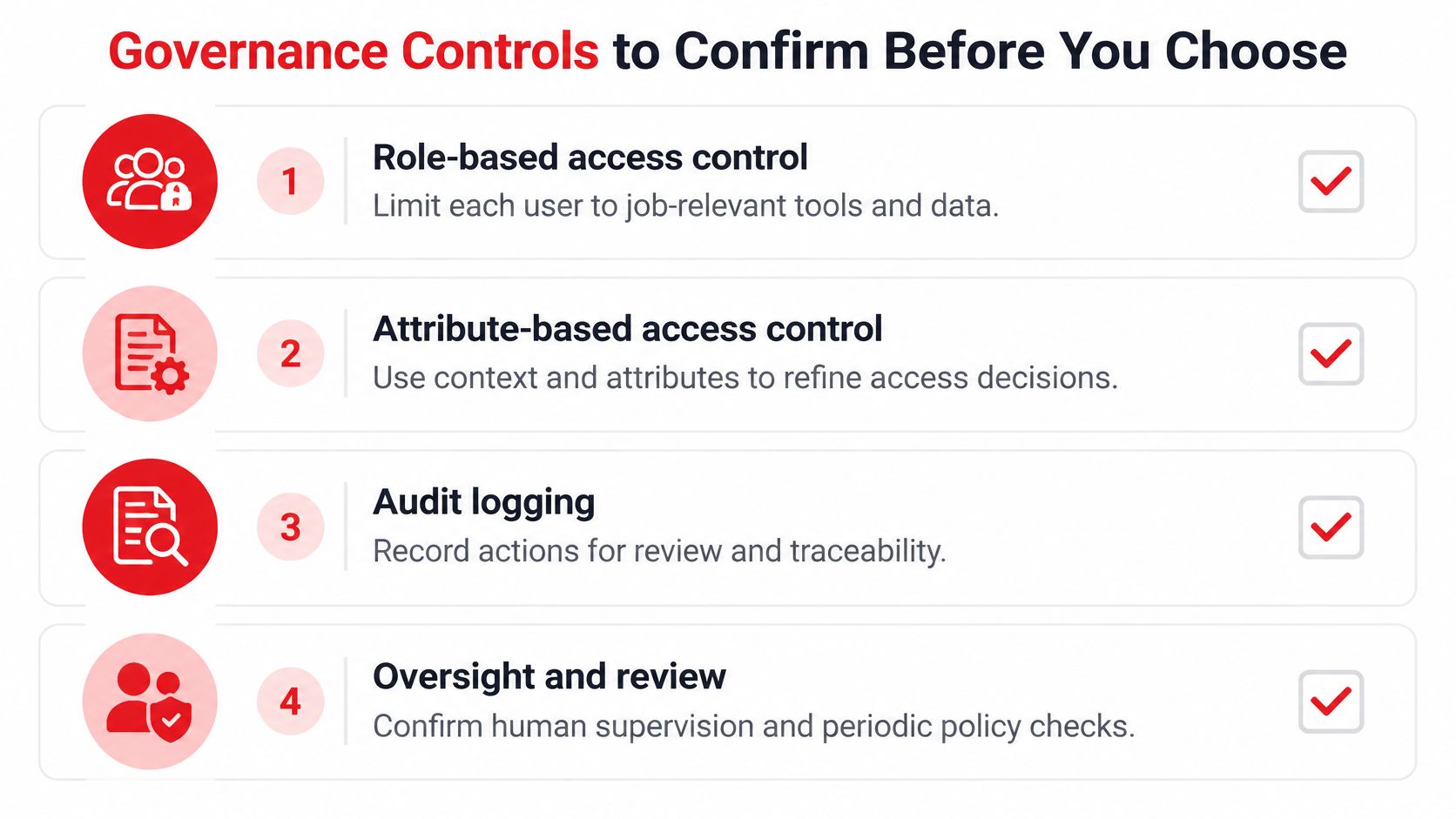
Access controls should be acceptance criteria, not items left for a post-launch security review. A submission published through NIST's AI information-gathering process identifies role-based access control, attribute-based access control, multifactor authentication, and access logging as relevant safeguards for sensitive information.
That guidance doesn't establish that any particular product implements these controls. Each control must be confirmed for the proposed Prox.ia deployment, with written answers from the responsible software provider.
Provider verification checklist
- Role-based access control: Which roles exist by default, and what can each role view, submit, export, and administer? The MSP should test ordinary employee and administrator accounts separately, including attempts to reach unauthorized client material.
- Attribute-based access control: Can attribute rules be configured, and which user or resource attributes can those rules evaluate? A requirement for department-specific documents should map to an enforceable rule, not an informal naming convention.
- Multifactor authentication: Which MFA methods are supported, and can enforcement cover administrators as well as ordinary users? Recovery and emergency-access procedures also need named owners.
- Access logging: How are access logs kept and exported? The written response should identify recorded events, authorized viewers, retention arrangements, and the process for investigating unusual activity.
The prompt moderation overview belongs in a separate content-handling review. Access authorization and prompt inspection answer different questions: permission to enter a workspace doesn't establish permission to submit every document.
Evidence must survive model changes
NIST's draft AI security guidance calls for monitoring and logging AI-related activity, including data and model access and version history. It also explains why dynamic environments with frequent model updates need continuing evidence rather than point-in-time snapshots.
The MSP should therefore establish how a reviewed answer can be associated with its model version and relevant access event. That requirement doesn't imply immutable logs, a particular retention period, or a certification. Those remain separate items requiring verification.
Oversight needs an owner. Assign responsibility for reviewing access changes, investigating incidents, and deciding when a model update requires renewed testing. Attach the completed control checklist and unresolved exceptions to each client's onboarding record before the workspace goes live.
Use-Case Matrix for Client AI Workspaces
The strongest LLM comparison starts with work employees are authorized to perform. This matrix presents illustrative pilot designs, not measured outcomes or promises about a particular platform.
Use cases, criteria and pilot tests
| Client Use Case | Criteria That Drive the Choice | Pilot Test | Failure to Watch For |
|---|---|---|---|
| Marketing and general drafting | Speed, cost per draft, tone control | Ten real briefs scored by two reviewers | Generic copy that needs heavy rewriting |
| Policy and procedure Q&A | Citation accuracy, calibrated refusals | Questions with known answers and questions with no answer | Confident answers with no source |
| Contract and report summaries | Long-context reliability, structured output | Key facts placed deep in documents | Missed clauses that conflict with appendices |
| Technical scripting and documentation | Output correctness, structured output | Scripts run in a sandbox before use | Plausible code that fails silently |
| Sensitive HR or personal data | Data policy fit, access controls, logging | Data-handling review before any test | Moderation missing sensitive items |
| Service report drafting | Structured-output success, cost per report | Three past reports regenerated and compared | Figures that do not match source data |
Match the review burden to the consequence
Marketing drafts can be evaluated for factual accuracy, tone, editing effort, and cost per accepted draft. Service report drafting adds a stricter reconciliation requirement: every reported figure should match the source record. A fluent narrative shouldn't compensate for incorrect customer reporting.
Policy Q&A and contract summaries require evidence-sensitive scoring. Reviewers should distinguish a missing clause from an incorrect interpretation and assess whether the answer identifies limitations. Technical scripting requires execution-based checks in a sandbox, including error handling and tests that detect silent failure.
Sensitive HR or personal-data work should pass a data-handling review before any test input is submitted. Synthetic or appropriately de-identified examples can support an initial evaluation, but they don't establish approval to process live employee records. High-risk workflows need human review whichever model is selected.
A multi-model workspace evaluation should establish which candidates and settings are available in the proposed environment. The matrix describes selection requirements, not a claim that routing, validation, or access enforcement happens automatically.
The same model can rank differently
Illustrative clinic example: For policy Q&A, a clinic gives calibration and citation accuracy greater weight than raw speed. A prompt refusal when evidence is missing may be preferable to an immediate, confident answer that staff can't substantiate.
Illustrative marketing example: A marketing team prioritizes cost per accepted draft and response speed, while reviewers check messaging and factual claims. The same candidate may rank well for that workflow and poorly for the clinic's task.
Selection rule: Weight the consequence of failure before comparing the convenience of success.
Record both weighted scores and disqualifying failures. An attractive average shouldn't override a prohibited data flow or a script that damages test data. A pilot grounded in the client's use case is more useful than leaderboard position alone.
Run a Pilot Before Committing to a Model
The client's data policy comes first: which documents employees may submit, which information is prohibited, and which model providers may process approved material. These permissions should be confirmed during onboarding, not inferred from the presence of a chat interface.
The Prox.ia governance position states that moderation doesn't remove every data risk, detect every sensitive item, replace a client data policy, or guarantee compliance. That boundary makes governance an ongoing service-delivery responsibility rather than a feature the MSP can enable and forget.
A repeatable pilot sequence
- Choose a narrow workload. Select two or three use cases from the matrix as an illustrative pilot scope. Include representative successful tasks, ambiguous requests, and cases that should be refused or escalated.
- Set data and access rules. Identify permitted inputs, authorized participants, approved processors, and the person who can approve exceptions. Use substitute material until live-data handling is authorized.
- Run identical prompts across candidates. Test within the proposed deployment, preserving the approved configuration. Retain outputs and execution records so reviewers can reproduce a failure rather than debate a screenshot.
- Score quality, latency, and cost together. Apply the client's acceptance criteria before reviewing model identities where practical. Separate unacceptable failures from ordinary editing needs, and document review labor alongside model usage.
- Review the result with the client before rollout. Present limitations, unresolved controls, support responsibilities, and the recommended permitted uses. The client should approve the operating boundary, not merely acknowledge a demonstration.
The pilot quantities above are a suggested test design, not evidence that a particular sample size guarantees reliable results. Expansion should follow the variety and consequence of the work being evaluated.
Turn approval into a service boundary
The final decision should name the approved deployment and model configuration, the permitted workflows, the budget owner, and the events that trigger reassessment. Changes to processing terms, model availability, document sources, or administrator permissions should prompt a review appropriate to their impact.
The MSP's recurring service can then focus on onboarding, administrator guidance, prompt workshops, adoption, and support. Those activities should be described separately from software functionality so the client understands what the MSP delivers and what the vendor supplies.
The best model is the one the MSP can operate responsibly for that client. If no candidate satisfies the deployment, evidence, and budget requirements, narrowing or postponing the workflow is a valid outcome.
Veevoo, Inc. is a software distribution and enablement partner that distributes Prox.ia and Volgap; the software vendors remain separate, and either platform can be adopted independently. MSPs can visit Veevoo, Inc. and arrange a fifteen-minute conversation with LeeJay Stewart to discuss AI service plans, IT visibility needs, or both, with the proposed client workflows and governance requirements ready for discussion.