
91% of companies say managed services are highly integrated into their digital transformation strategy, and 87% identify AI implementation as a critical capability. For an MSP owner, that points to a practical opportunity: package AI as an ongoing managed service with onboarding, governance, user support, training, and recurring reviews.
An MSP client may already be using public AI tools across sales, finance, operations, and customer support. The owner may know that employees are experimenting, but not which accounts are active, what information is being entered, or whether departing users still have access. The service desk receives questions about prompts, the security team worries about sensitive data, and the account manager has no repeatable offer to put in front of the client.
That gap is where a managed AI service becomes more useful than another one-time deployment. Cybersecurity has already taught buyers to pay for continuous oversight, policy management, incident handling, and reporting. AI needs a similar operating model, particularly when an MSP is responsible for helping SMB employees use a governed workspace rather than sending them toward unmanaged public tools.
Table of Contents
- Why Managed AI Is the Next MSP Revenue Frontier
- Core Components of a Managed AI Workspace
- Packaging Your AI Offer for SMB Clients
- Managing Risk with Governance and Moderation
- Driving Adoption Through Prompt Workshops
- Integrating AI Services with Existing MSP Tools
- Getting Started with Prox.ia
Why Managed AI Is the Next MSP Revenue Frontier
An MSP that treats AI as a software installation will usually finish when access is provisioned. An MSP that treats AI as a service keeps working after launch. It helps the client choose practical use cases, establishes acceptable data handling, supports users, reviews adoption, and adjusts controls as the client's needs change.
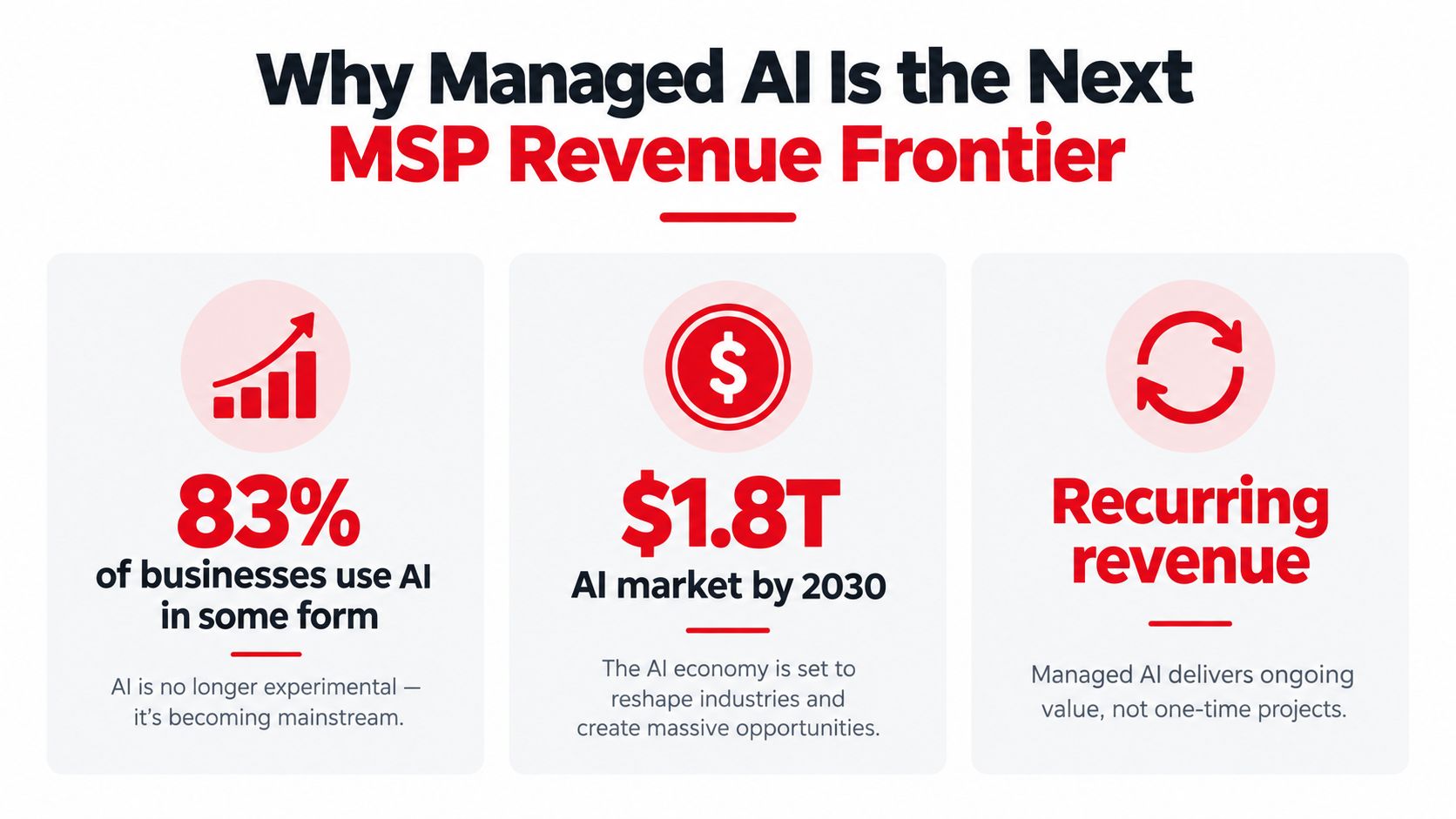
That distinction matters because AI adoption is commercially important but operationally incomplete. In a December 2024 survey of 195 MSPs, 90% rated AI as either very important or somewhat important to their growth strategy, while 83% believed AI would significantly contribute to revenue growth within two years, according to MSP-specific research on accelerating AI with managed services. Yet only 41.5% said AI was integrated into 26% to 50% of their solutions, platforms, and services. The commercial appetite is ahead of delivery standardization.
The opportunity behind shadow usage
A typical client conversation starts with a discovery problem. Employees have found their own AI tools, department leaders have adopted different workflows, and the IT team is asked to approve the arrangement after the fact. The MSP may be managing endpoints and identities, but the AI activity sits outside the regular service catalog.
The first service motion should not be a promise that AI will replace existing work. It should be a controlled path from scattered experimentation to accountable use:
- Discover current use: Identify which teams are using public AI services and what business tasks they're trying to improve.
- Classify exposure: Separate ordinary business content from customer, financial, regulated, and source-code information.
- Create an approved workspace: Give users a defined place to work, with centrally managed access and documented policies.
- Review usage: Discuss adoption, support questions, policy events, and new use cases during recurring service meetings.
This is a natural extension of the managed-services relationship. KPMG reports that 63% of respondents use managed services for cybersecurity across an entire business function or enterprise, while AI management reaches nearly 50% of adopters at those same levels, as detailed in its Managed Services Outlook 2026. The implication is straightforward. Buyers already understand recurring oversight for high-trust technology, and MSPs can apply that expectation to governed AI without reducing the service to a single deployment project.
Core Components of a Managed AI Workspace
A public AI portal gives an employee a place to submit a prompt. A managed workspace gives the MSP and client a service boundary around that activity. The difference is not merely the number of models available. It is the presence of administration, usage rules, support procedures, and a review process that can continue after onboarding.
A practical Prox.ia offer should be verified against the proposed deployment before it is sold. The platform is described as a multi-model AI workspace for client employees working with text, documents, images, and code, with the exact model access and deployment options requiring confirmation. The Prox.ia multi-model AI workspace can serve as the product layer, while the MSP supplies the recurring service wrapped around it.
What the MSP actually manages
The service manager owns the operating rules, not the client's business judgment. The client decides which prompts and outputs support its work. The MSP defines how users receive access, how administrators handle changes, how policy questions are escalated, and how adoption is reviewed.
| Area | Standard public AI tool | Managed AI workspace |
|---|---|---|
| Access | Often controlled by individual accounts | Centrally administered access, subject to the confirmed deployment |
| User support | Provider documentation or informal internal help | MSP onboarding, support procedures, and prompt workshops |
| Data policy | Employee interpretation may vary | Client policy is translated into workspace guidance and controls |
| Usage review | Limited visibility for the MSP | Recurring review of available usage and moderation reporting |
| Commercial model | Usually a software purchase | Workspace access combined with an MSP service motion |
The table describes an operating distinction, not a promise that every control is available in every Prox.ia deployment. Client branding, private or on-premises options, cloud placement, model availability, and specific administrative functions should be confirmed before a proposal is finalized.
Why governance belongs in the offer
Governance should be treated as a recurring deliverable. A channel example frames managed AI governance as assess, control, monitor, and report, with activities such as use-case classification, identity and access controls, policy exception management, and recurring governance reporting, as described in Channel Insider's guidance for AI governance services for MSPs.
That framework gives a service manager something concrete to schedule. The account team can sell an initial assessment, the technical team can configure approved access, the service desk can handle users, and the account manager can review exceptions and adoption during a regular meeting. Without those recurring motions, the workspace risks becoming another underused license.
Packaging Your AI Offer for SMB Clients
A service tier should reflect the client's readiness, not the MSP's desire to expose every available feature at launch. Many SMBs need a controlled starting point, clear user guidance, and a small number of practical workflows before they need a complex governance program.
The package should separate one-time onboarding from recurring management. Onboarding establishes the baseline. The monthly service maintains it.
Build the onboarding checklist
A service delivery manager can structure the first engagement around the following sequence:
- Define the business owners. Identify the executive sponsor, technical administrator, department contacts, and escalation path for policy questions.
- Map initial use cases. Select practical workflows such as drafting internal communications, summarizing approved documents, or preparing first-pass research. Label these examples as illustrative, not guaranteed outcomes.
- Set the data boundary. Document what employees may submit and what must remain outside prompts and file uploads.
- Provision the workspace. Configure users and administrative settings that are available in the confirmed Prox.ia deployment.
- Run the first workshop. Teach users how to write useful prompts, check outputs, and handle uncertain responses.
- Schedule the review. Put adoption, support issues, policy questions, and requested changes on the recurring service calendar.
The MSP should own administration and governance. The client should own the business context, the prompts employees choose, and the decision to use or reject an output. That division prevents the MSP from becoming responsible for every customer communication or internal decision produced with AI assistance.
Use maturity-based packaging
A straightforward offer can have a controlled entry package, an adoption package, and a more involved governance package. Names and pricing should remain specific to the MSP's catalog.
- Foundation: Workspace onboarding, user administration, documented data policies, and basic support.
- Adoption: Everything in Foundation, plus prompt workshops, department use-case reviews, and scheduled adoption discussions.
- Governance: Everything in Adoption, plus structured policy reviews, exception handling, moderation reporting, and management reporting where supported by the deployment.
Consumption budgets should be discussed during onboarding rather than treated as an afterthought. The MSP can establish an internal approval process for budget changes, while the client decides which departments receive access and what level of use fits its operating plan.
Commercial rule: The recurring fee should pay for named activities, not vague access to “AI expertise.” Every package needs an owner, a cadence, and a client-facing output.
Managing Risk with Governance and Moderation
A user pastes customer records into a public AI tool, then asks the MSP whether the incident counts as a breach. That question exposes the operating gap: a policy without visibility leaves the client and service team guessing. Governance should define approved tools, data boundaries, access ownership, and the evidence retained when a rule is triggered.
The strongest starting position is to discover shadow AI before trying to eliminate it. The MSP should identify which users and devices reach public AI services, classify the information involved, and move approved activity behind centrally managed identity and logging. Guidance for MSPs recommends SSO, explicit user attribution, and immediate revocation when access changes. It also says customer, financial, regulated, and source-code data should be blocked from prompts and file uploads, as outlined in shadow AI governance guidance for MSPs.

Moderation needs a human operating procedure
A moderation alert is an event, not a finished investigation. The service desk or security team needs a documented response that names the reviewer, sets retention limits, defines when the user is contacted, and identifies when the client's designated owner must approve an exception. Review the Prox.ia prompt moderation overview for context on using moderation records during governance reviews.
A practical procedure can include:
- Classify the event: Determine whether the activity involves prohibited data, a questionable business use, or an apparent false positive.
- Protect the account: Apply the available access or policy response while the event is reviewed.
- Record the decision: Note the user, business purpose, policy rule, action taken, and approver.
- Improve the guidance: Update the client policy when the same confusion appears repeatedly.
The private deployment question requires equal care. A private boundary does not automatically keep every model call inside that boundary. The application, retrieval layer, storage, and model endpoints may sit in a cloud VPC, on-premises, or hybrid environment, while prompts, retrieved documents, and outputs follow different integration paths. Review each path, as explained in private AI deployment guidance on data-flow scoping.
Security principle: A managed AI service should describe what the controls do, what they don't do, and which decisions remain with the client.
That clarity supports renewal conversations. Clients can assess the service through recorded events, unresolved questions, policy decisions, and agreed remediation, rather than treating moderation as a complete compliance solution. The MSP can then report those outputs on a defined cadence and show the work performed under the recurring agreement.
Driving Adoption Through Prompt Workshops
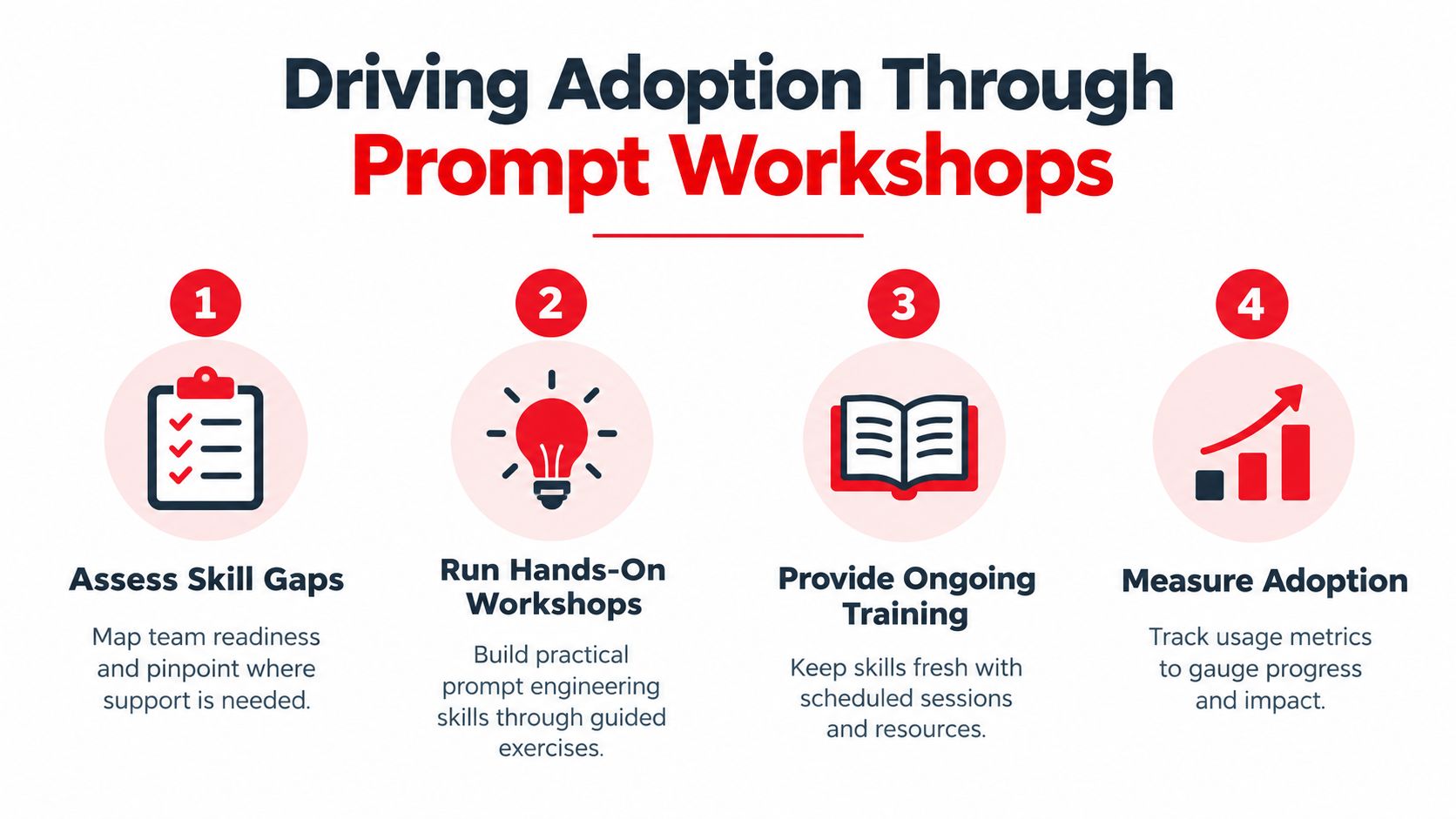
Workspace access doesn't create useful habits on its own. Employees need practice with the tasks they already perform, and managers need a way to distinguish occasional experimentation from repeatable adoption.
Turn training into a delivery motion
A prompt workshop should use sanitized, illustrative examples from the client's own workflows. A finance team might practice turning an approved policy document into a draft checklist. A sales team might compare prompts for summarizing a discovery call, provided confidential information is handled according to the client's policy.
The workshop should cover four behaviors:
- State the task: Tell the model what outcome the employee needs.
- Supply safe context: Provide only information approved for the workspace and use case.
- Specify the format: Request a structure that makes review easier.
- Check the result: Confirm facts, tone, calculations, and missing context before use.
Review adoption without rewarding careless volume
Usage is only one signal, and higher usage isn't automatically better. The MSP should combine available workspace reporting with workshop attendance, support themes, accepted use cases, and policy events. A department that produces fewer prompts but uses outputs carefully may be healthier than a department generating large volumes without review.
Existing MSP practices help here. The PSA can hold workshop tasks, follow-up actions, and service review notes. The RMM and security stack remain complementary tools for the devices and identities that access the workspace. They don't become AI governance platforms because the MSP adds Prox.ia to the service catalog.
The recurring review should answer practical questions: Which teams need another workshop? Which prompts create confusion? Which use cases should be approved, revised, or stopped? That conversation gives the account manager a reason to engage the client beyond license administration.
Integrating AI Services with Existing MSP Tools
The AI workspace should be added to the MSP's delivery system, not placed beside it as an unmanaged exception. RMM, PSA, identity, and security tools continue to perform their existing roles. The managed AI service adds a defined workflow for workspace administration, user support, data-policy questions, and adoption activity.
A service manager can connect the motions without claiming unsupported product integrations. The connection may be procedural rather than automated, and any specific connector or integration must be confirmed against the MSP's stack and the proposed Prox.ia deployment.
Create the service workflow
A workable operating sequence looks like this:
- Open the request in the PSA. New-user access, user removal, policy questions, workshop requests, and moderation events receive service records.
- Validate identity and ownership. The administrator confirms the user, department, client approver, and requested level of access.
- Check the endpoint context. Existing RMM, identity, and security tools help the MSP understand whether the request comes from an expected managed environment.
- Complete the workspace action. The administrator applies the available Prox.ia configuration and records the decision.
- Close with evidence. The ticket records the action, approver, date, and any follow-up required at the next service review.
Billing needs similar discipline. The MSP should define whether the recurring service is priced around enrolled users, administration effort, workshops, reporting, or another documented unit. Usage information can inform a review, but the billing system should remain the source of truth for what the client purchased.
Keep reporting useful for the client
A monthly or quarterly report should focus on decisions rather than decorative activity. Useful sections may include active service scope, users added or removed, workshops delivered, open policy questions, moderation events where reporting is available, and recommended changes.
The report should also distinguish platform information from MSP interpretation. If a model, deployment option, access control, or report field has not been verified for the client's configuration, it should be marked for confirmation rather than presented as a guaranteed feature.
Delivery rule: Every recurring review should produce an action, an owner, or a documented decision. Otherwise, the meeting is only a status update.
Getting Started with Prox.ia
An MSP can launch a managed AI service without attempting to standardize every client workflow at once. The sensible starting point is a defined workspace, a short onboarding checklist, clear data policies, user support, and a scheduled adoption review.
Prox.ia is positioned for MSPs that want to resell a multi-model AI workspace and build services around access, administration, prompt workshops, data policies, and ongoing support. The Prox.ia MSP reseller information can help a service owner assess the reseller model, while the main Prox.ia product page provides the product context. Deployment choices, client branding, model access, private or on-premises options, and specific controls should be confirmed before the MSP commits them to a client proposal.
A practical launch plan has three parts:
- Select a pilot client: Choose an SMB with a clear business sponsor and manageable initial use cases.
- Document the service: Define onboarding, administration, support response, workshops, review cadence, and escalation ownership.
- Measure service health: Track completed actions, adoption questions, policy events, and renewal decisions without promising unsupported performance results.
The service becomes defensible when the MSP delivers these activities consistently. AI access is only the starting point. The value of the managed AI service comes from helping employees use the workspace responsibly while giving client leaders a clear operating rhythm.
Veevoo, Inc. distributes Prox.ia and works with MSPs evaluating governed AI workspace services, reseller delivery, and implementation planning. MSP owners can visit Veevoo, Inc. to discuss how to shape onboarding, support, prompt workshops, and recurring adoption reviews around a client-ready offer.
Created with Outrank tool