
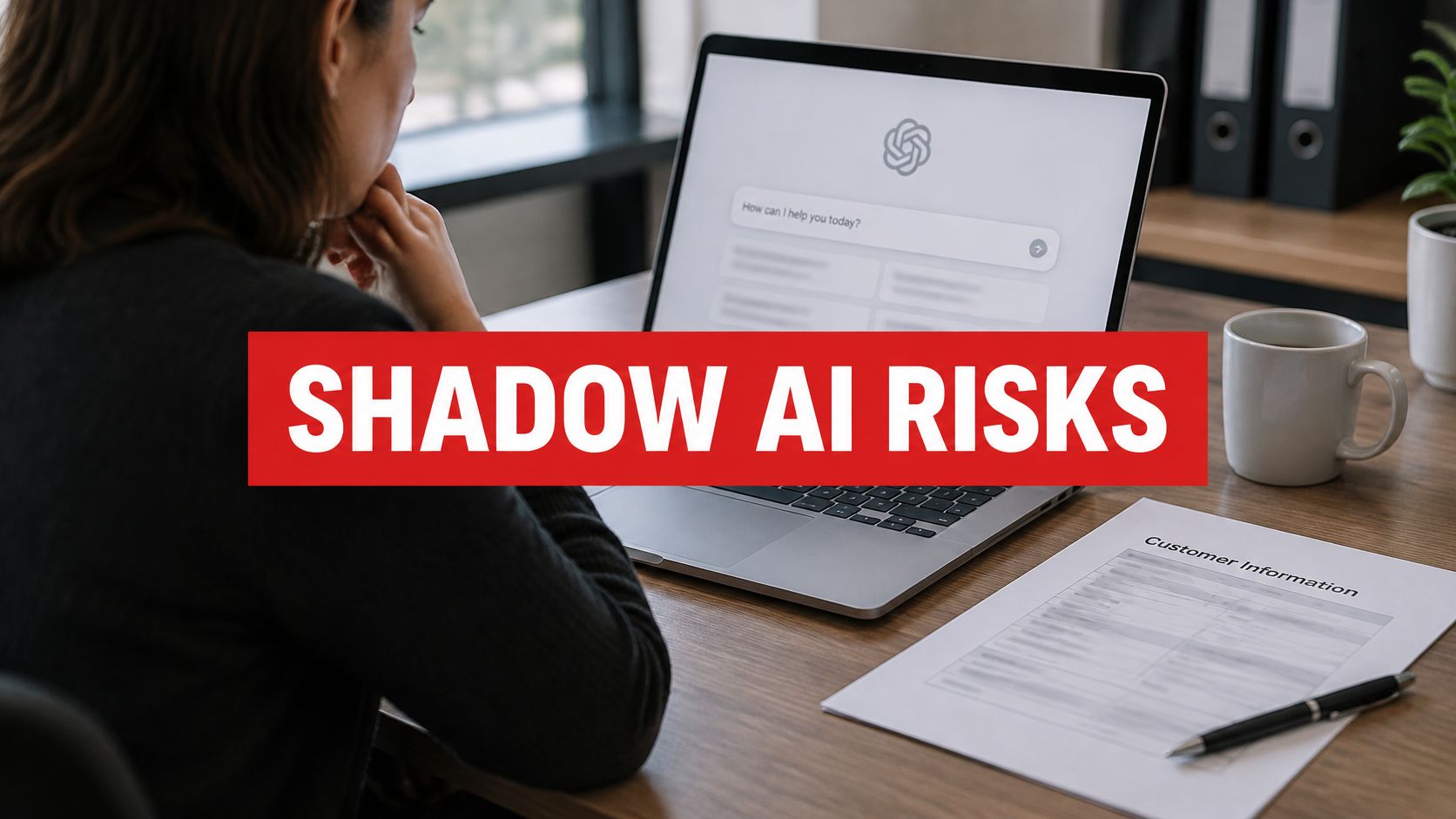
A client employee pastes a customer contract into a free public chatbot to draft a summary. The summary looks useful, so it goes into an email. In this illustrative scenario, the MSP never sees which tool received the contract, which account the employee used, or whether the provider retained the submission.
That's the client problem behind shadow AI risks. Employees want useful tools now, while the MSP needs defensible data-handling practices. A workable service must address both, with an assessment, an approved alternative, and ongoing accountability rather than another policy document nobody consults.
Table of Contents
- What Shadow AI Means for Your MSP Clients
- Why Employees Turn to Unapproved AI Tools
- The Real Risks of Unmanaged AI Use
- How Shadow AI Leads to Data Exposure
- Building an Approved AI Workspace Plan
- Turning Shadow AI Governance into a Client Service
What Shadow AI Means for Your MSP Clients
Shadow AI is work-related AI use that happens without organizational approval or oversight. For an SMB client, that could mean a personal chatbot account, an unreviewed coding assistant, or an AI application connected to business information without a documented decision.
The important distinction is between business authorization and employee access. An employee's ability to open an application doesn't establish permission to submit client records or confidential documents. Likewise, paying for an AI subscription doesn't establish that its processing terms meet the organization's requirements.
The client relationship problem
In the contract example, the employee may have been authorized to read the document. The unresolved question is whether the employee was authorized to send it to that particular external service. Those are different permissions, and the MSP needs the client's business owner to understand the difference.
When the client asks whether the contract is safe, an honest answer may require information the MSP doesn't possess. Without the account details, provider terms, submission history, and relevant settings, reassurance would be speculation.
Practical rule: Treat an unknown AI data flow as an assessment finding, not proof of a breach and not evidence that everything is safe.
A written acceptable-use policy establishes expectations, but it doesn't show what employees submit. The MSP should distinguish between a policy being published, employees understanding it, and controls producing evidence that supports it.
Define responsibility before accepting it
An MSP can coordinate AI governance without becoming the client's legal authority or accepting unlimited responsibility for employee decisions. A useful division of responsibilities includes:
- Client leadership: Approves business uses, permitted information, and accepted exceptions.
- MSP service owner: Coordinates assessment, workspace administration, onboarding, and reporting within the agreed scope.
- Legal or compliance advisers: Interpret contractual and regulatory obligations when specialist judgment is necessary.
This makes shadow AI governance a defined service rather than an informal promise to make every AI interaction safe. The MSP's deliverable is a documented process with clear ownership, known limitations, and an accessible route for employees who need help.
Why Employees Turn to Unapproved AI Tools
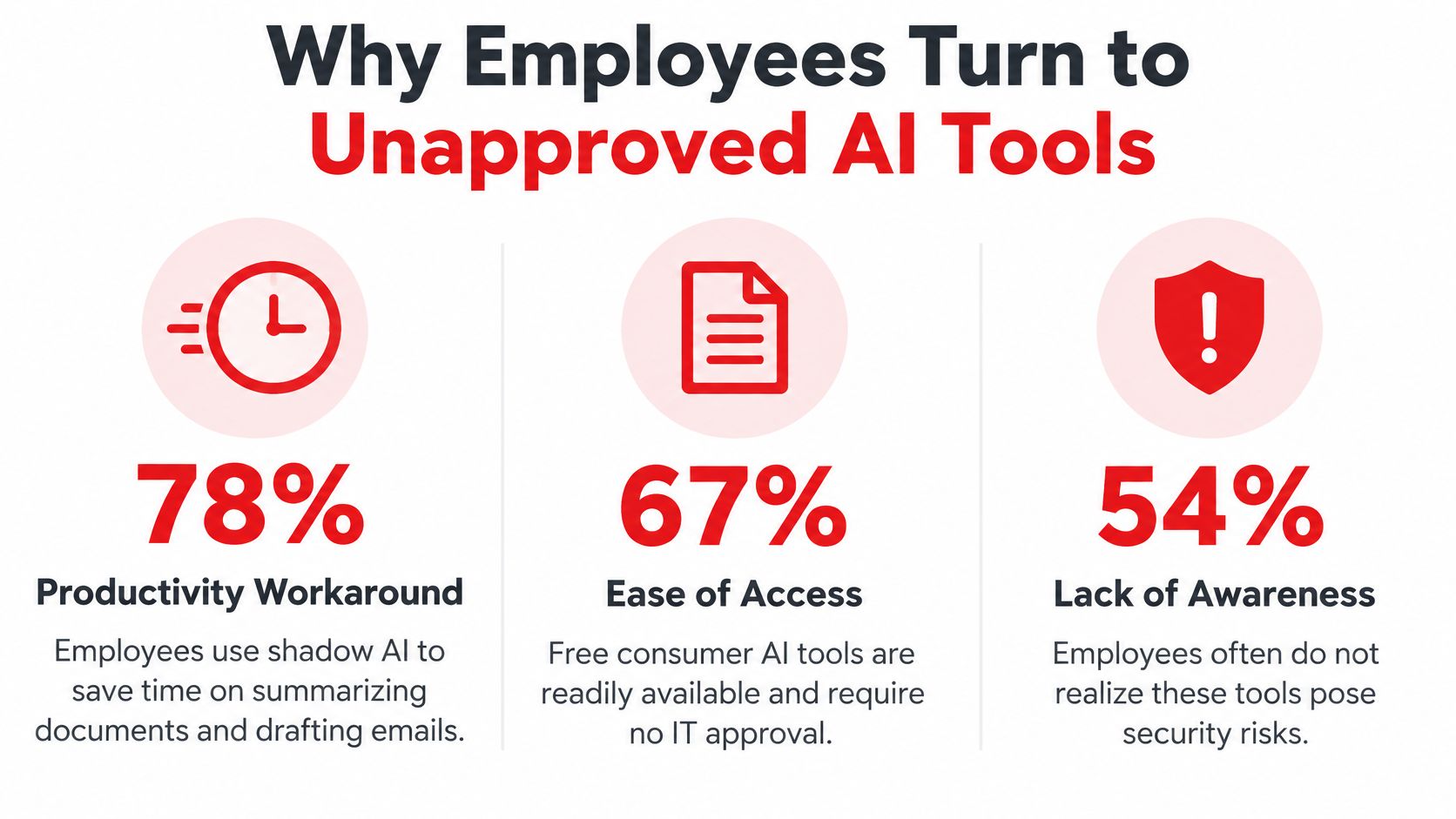
Employees don't necessarily choose an unapproved application because they reject security. They may choose it because it solves an immediate problem: summarizing a document, drafting a response, analyzing a spreadsheet, or explaining unfamiliar code.
An IBM-sponsored 2025 study found that 80% of surveyed U.S. office workers used AI at work, while only 22% relied exclusively on employer-provided tools. Among Gen Z respondents aged 18–24, 35% said they were likely to use only personal AI applications, compared with 14% among other age groups, according to IBM's analysis of AI adoption and shadow risks.
Investigate the workflow, not just the application
Those findings establish an adoption gap. They don't establish that every personal application user acted maliciously, submitted sensitive information, or caused an incident. They also shouldn't become a reason to single out younger employees for enforcement.
The more useful assessment question concerns the task that led an employee outside the approved environment. A tool inventory without that context can produce a list of applications to block while leaving the underlying business requirement unresolved.
Employee interviews should establish:
- The intended result: What work did the employee expect the AI tool to perform?
- The practical advantage: Was the appeal document handling, model quality, familiar access, or another workflow requirement?
- The approval obstacle: Did the employee know an approved option existed, and did that option support the task?
- The input assumption: What made the employee believe the information was appropriate to submit?
Restriction has a place, but it needs an alternative
An MSP shouldn't leave a clearly unacceptable data flow running merely because employees find it convenient. Immediate containment may be appropriate when sensitive information is being submitted outside an authorized process.
However, a blanket restriction can leave employees with the same deadlines and no workable replacement. A stronger plan pairs restrictions with approved workflows, a responsive exception process, and training built around actual job tasks.
For an illustrative marketing workflow, an approved tool might handle drafts based on public product information while excluding unpublished customer contracts. That distinction is more actionable than a general instruction to use AI responsibly. Employees need to know which task is allowed, which inputs are allowed, and where uncertainty should go.
The Real Risks of Unmanaged AI Use
IBM reported that organizations with high shadow AI use incurred USD 670,000 more in average breach costs than organizations with low or no shadow AI use. The same reporting found that only 37% of organizations had policies intended to manage AI or detect shadow AI, according to IBM's examination of AI-related breach costs and governance.
These findings support a business case for governance, but they require careful interpretation. The cost difference is an observed average, not a guaranteed loss for an SMB client or a forecast of savings from buying a workspace.
Separate the exposure mechanisms
Confidential documents, source code, customer records, and credentials require different responses. A submitted contract raises processing and confidentiality questions; an exposed credential may also require revocation or rotation. Treating both as a generic policy violation can delay the right action.
Provider behavior matters too. The MSP should establish applicable storage, retention, deletion, and model-improvement terms rather than assume every public AI service handles submissions identically.
Shadow AI Risk Comparison
| Risk Dimension | Unmanaged AI Use | Managed AI Workspace |
|---|---|---|
| Authorization | Employee selects an application without review | Approved uses and responsible owners are documented |
| Data handling | Processing and retention terms may be unknown | Terms are reviewed against client requirements |
| Access | Personal accounts may sit outside client administration | Administrative access requirements are defined and verified |
| Visibility | Evidence may be unavailable or fragmented | Available reporting is evaluated before deployment |
| Response | Ownership and escalation may be unclear | Incident and exception procedures are assigned |
| Residual risk | Neither boundaries nor limitations are established | Known limitations remain subject to review |
The managed column describes target governance outcomes, not capabilities guaranteed by any particular product. Each outcome needs evidence from the proposed deployment and the MSP's operating procedures.
Approval doesn't remove judgment
A governed workspace can still receive an inappropriate prompt, produce inaccurate output, or be used for a workflow the client never approved. Controls should therefore address both submissions and the decisions employees make with generated results.
A workspace can be approved while a particular use of it remains prohibited.
The practical trade-off is between collecting useful evidence and creating another sensitive repository. Prompt logging, where available, should have defined access and retention rules. An MSP shouldn't copy confidential submissions into broadly accessible service tickets merely to demonstrate that monitoring occurred.
How Shadow AI Leads to Data Exposure
The exposure problem becomes clearer when the MSP traces information from its business source to its external destination. The following scenarios are illustrative, not reported customer incidents.

Illustrative scenarios from ordinary workflows
- Customer outreach: A sales employee uploads a customer list to generate personalized messages. The assessment must establish which fields left the business environment, which account received them, and whether the resulting messages were stored or redistributed.
- Code troubleshooting: A developer pastes a source-code excerpt into an unapproved assistant. The review should distinguish proprietary logic from embedded credentials, because a secret in the submission may require an immediate security response.
- Financial analysis: A finance employee submits internal forecasts through a personal AI account. The resulting chart may later enter a management presentation, leaving both the original submission and the derived output within the investigation's scope.
These examples aren't equivalent to confirmed breaches. They show how routine work can create an unauthorized transfer that needs investigation.
IBM's 2025 Cost of a Data Breach research found that 20% of studied organizations experienced a breach involving shadow AI, with those incidents averaging approximately USD 4.63 million, according to the IBM and Ponemon Institute report. That population-level finding doesn't determine the outcome or cost of any illustrative scenario.
Reconstruct the data flow before closing the finding
A domain connection establishes contact with a service, not the contents of a prompt. An application inventory establishes presence, not whether confidential data was submitted. Human investigation may still be necessary to establish the account, information, timing, processing terms, and downstream distribution.
The MSP should preserve available evidence and involve the client's designated incident owner when warranted. Removing an application alone doesn't resolve questions about information already transmitted.
The Prox.ia prompt moderation overview is a relevant evaluation starting point for submission controls. Its proposed role should remain separate from incident investigation: evaluating moderation for future use doesn't establish what happened in an earlier personal-account interaction.
Building an Approved AI Workspace Plan
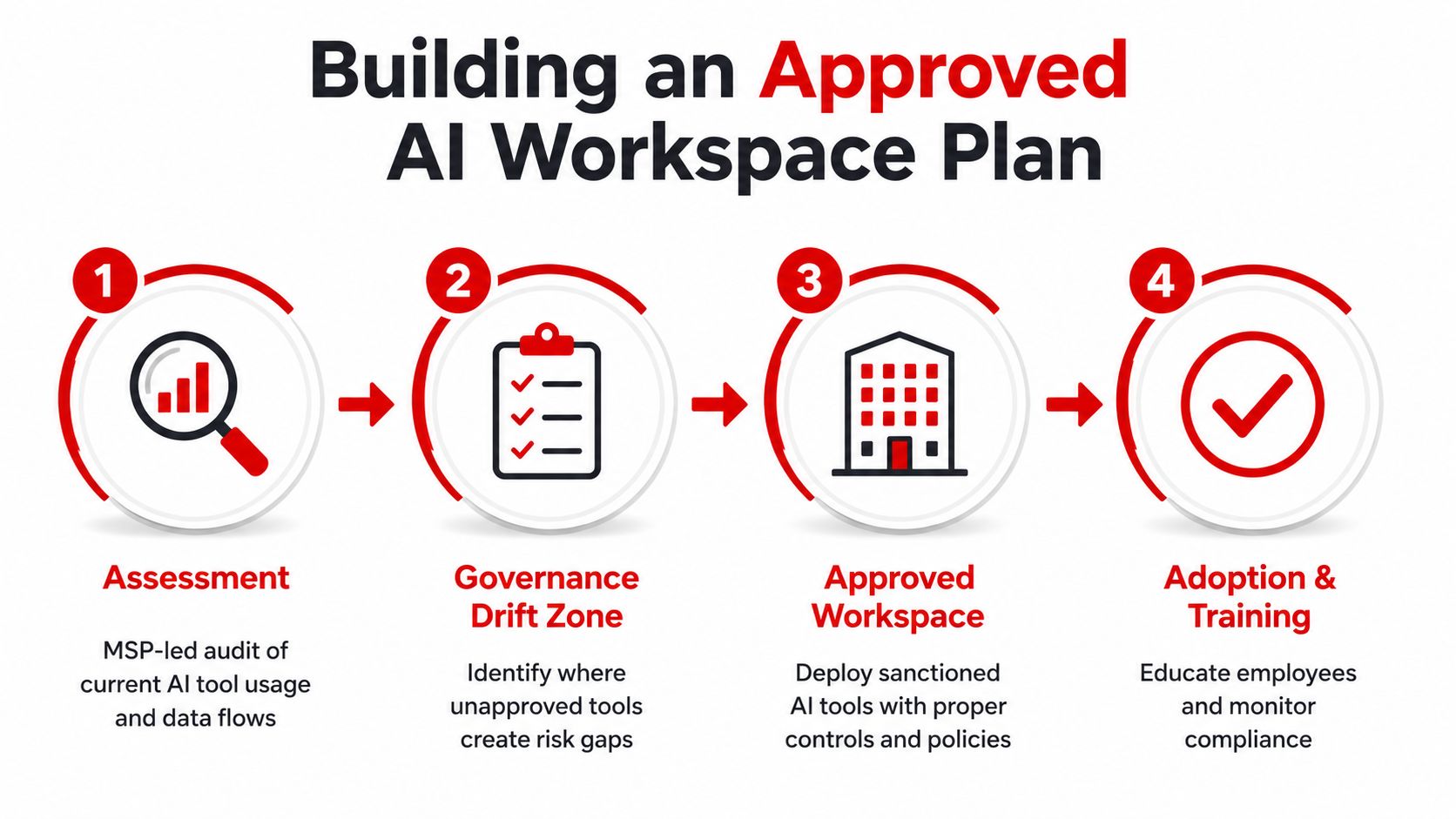
A 2025 mixed-methods study of 140 professionals and 10 executives identified a governance drift zone, where formal policies lacked practical traction. Its recommendations included tool registries, role-specific training, internal audits, and escalation paths rather than restriction alone, as described in the study on AI governance drift.
The operational implication is straightforward: an approved alternative must fit the work. Otherwise, the MSP may deploy a platform without changing the behavior that created the exposure.
Establish the assessment baseline
Start with employee interviews and a tool register, then validate findings against available technical evidence. Review browser extensions, SaaS OAuth grants, and relevant DNS or secure-web-gateway events where the client has authorized access.
The assessment should produce usable decisions:
- Known applications: Identify business owners, account types, and unresolved provider questions.
- Legitimate workflows: Separate useful tasks from uses that require prohibition or specialist review.
- Information boundaries: Define public, internal, confidential, and restricted inputs using client-specific examples.
- Exceptions: Assign an approver and review conditions for new tools or models.
Document coverage limitations. An assessment shouldn't be described as complete merely because the MSP reviewed the systems under its management.
Validate the workspace against client requirements
Prox.ia is a candidate for an approved AI workspace, not a substitute for the assessment. Its multi-model AI workspace information provides a starting point for evaluating model choice against approved client workflows.
Before deployment, confirm model availability, supported content types, administrative controls, reporting, consumption budgets, and provider-processing requirements. Client branding and cloud, private, or on-premises options must also be confirmed for the proposed environment.
The Prox.ia product guidance explicitly states that moderation helps control supported sensitive-content categories but doesn't replace a client data policy, detect every sensitive item, or guarantee compliance. Those limitations belong in onboarding documentation, not just procurement notes.
Test adoption before expanding access
Pilot approved tasks with representative employees using synthetic or appropriately cleared inputs. Record whether the workspace supports the task, whether outputs need correction, and where employees encounter friction.
Service boundary: Approval should apply to a defined workflow and data category, not unrestricted use of every available model.
Onboarding should include hands-on examples, output-review expectations, and a clear reporting path for mistakes. New workflow requests should follow a documented approval process, while recurring reviews should revisit policies when client requirements or provider terms change.
Turning Shadow AI Governance into a Client Service
The commercial opportunity is a repeatable operating service, not a promise to eliminate AI risk. A 2025 survey of 200 U.S. enterprise IT directors and executives found that 90% were concerned about shadow AI, while 79% reported negative outcomes from sending corporate data to AI, including personal-data leakage and inaccurate results, according to Komprise's enterprise IT survey.
Those enterprise findings shouldn't be projected directly onto SMBs. The MSP should sell against the client's assessed needs, particularly where no internal owner has responsibility for AI governance.
Package defined deliverables
| Service Component | Client Deliverable |
|---|---|
| Initial assessment | Tool register, prioritized findings, and adoption recommendations |
| Workspace onboarding | Approved workflows, administrator guidance, and employee training |
| Recurring administration | Scoped user support, configuration reviews, and exception handling |
| Monthly review | Evidence-based discussion of adoption, risks, consumption, and corrective actions |
The Prox.ia MSP reseller information can support evaluation of the workspace offering. The MSP should separately define its own assessment scope, support obligations, exclusions, and commercial terms.
Monthly reporting should distinguish approved adoption from unresolved exposure. Useful measures include unknown tools awaiting review, high-risk workflow exceptions, training completion, output-error incidents, and usage against client-defined budgets where reporting supports it.
A moderation event needs context, and an application count isn't proof of business value. Recurring revenue is defensible when the MSP performs recurring work: investigating findings, resolving adoption obstacles, and documenting decisions with the client.
Veevoo, Inc. distributes Prox.ia and provides software distribution and enablement support for MSPs evaluating client AI services. MSPs considering a shadow AI assessment and approved-workspace offering can contact the Veevoo team to discuss deployment fit, governance requirements, and service boundaries before making client commitments.